
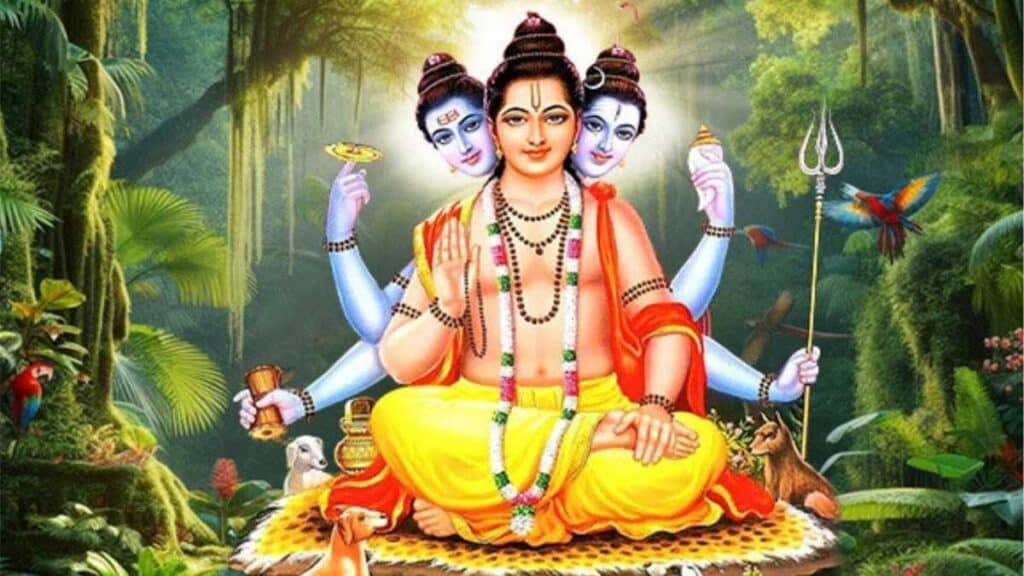
Datta Jayanti, also known as Dattatreya Jayanti, is a revered Hindu festival commemorating the birth anniversary of Lord Dattatreya — the divine embodiment of the Hindu Trimurti: Brahma, Vishnu, and Shiva. Celebrated on the full moon (Purnima) of the Margashirsha month in the Hindu lunar calendar, the festival falls in December or early January each year.
Known as the Adi Guru — the first and foremost spiritual teacher — Dattatreya is a central figure in the Datta Sampradaya tradition and is venerated across Maharashtra, Karnataka, Andhra Pradesh, Gujarat, and Telangana. The day is marked by fasting, puja, bhajans, reading of sacred texts, and temple pilgrimages. For devotees, it is above all a day to honor the guru within and without, and to reflect on the path of spiritual wisdom.
When Is Datta Jayanti Celebrated in 2026?
Datta Jayanti is observed on the Margashirsha Purnima — the full moon of the ninth month of the Hindu lunar calendar — which typically falls in December.
Datta Jayanti 2026 Date and Timings (India)
Date: Wednesday, December 23, 2026
Tithi: Margashirsha Purnima
Purnima Tithi Begins: 10:47 AM on December 23, 2026
Purnima Tithi Ends: 06:57 AM on December 24, 2026
All timings are in IST (Indian Standard Time) as per New Delhi. In the Hindu Panchang, the day begins and ends with sunrise.
Table of Contents
Datta Jayanti In USA, Canada, Australia, New Zealand, UK, UAE, Singapore 2026 Dates
Dattatreya Jayanti on Wednesday, December 23, 2026
Dattatreya Jayanti on Wednesday, December 23, 2026
Dattatreya Jayanti on Wednesday, December 23, 2026
Dattatreya Jayanti on Wednesday, December 23, 2026
Dattatreya Jayanti on Wednesday, December 23, 2026
Dattatreya Jayanti on Wednesday, December 23, 2026
Why Does the Date Change Every Year?
Datta Jayanti follows the Hindu lunisolar calendar rather than the Gregorian calendar. Since lunar months are shorter than solar months, the date of Margashirsha Purnima shifts each year, typically landing somewhere in December or occasionally in early January. The exact timings for the Purnima Tithi are calculated using planetary positions and local sunrise, making Datta Jayanti a movable festival rather than a fixed-date observance.
Datta Jayanti Overview
Datta Jayanti is a spiritually profound festival observed by followers of the Datta Sampradaya and Hindus across several states of India. Lord Dattatreya, worshipped as a combined form of Brahma, Vishnu, and Shiva, is revered as a wandering ascetic and supreme guru who embodies all divine qualities simultaneously. The festival is a day of fasting, devotion, and inner reflection — less about external spectacle and more about the quiet, transformative power of the guru’s grace.
The festival carries particular importance in Maharashtra, where it is one of the most widely observed religious occasions of the winter calendar.
Other Names and Regional Identities
| Language / Region | Name |
|---|---|
| Sanskrit | Dattātreyajayantī (दत्तात्रेयजयंती) |
| Hindi | Dattatreya Jayanti |
| Marathi | Datta Jayanti |
| Kannada | Dattatreya Jayanti |
| Telugu | Dattatreya Jayanti |
| Gujarati | Datta Jayanti |
In diaspora communities across the USA, UK, Canada, and Australia, the festival is commonly referred to as Datta Jayanti or Dattatreya Jayanti. Some communities also use the name Datta Purnima, reflecting the full moon occasion on which it falls. In the Datta Sampradaya tradition, the greeting Jai Gurudev is universally used.
Origins, History, and Legends
The birth of Dattatreya is rooted in one of the most beloved stories in Hindu mythology. Anasuya, wife of the sage Atri, was renowned throughout the three worlds for her extraordinary virtue. She performed intense tapas (austerities) to be blessed with a son possessing the combined merits of Brahma, Vishnu, and Shiva.
The consorts of the Trimurti — Saraswati, Lakshmi, and Parvati — grew concerned and sent their husbands to test Anasuya’s chastity. The three gods arrived disguised as sanyasis and made an impossible request: that she serve them alms unclothed. Without hesitation, Anasuya sprinkled water on them while chanting a mantra, transforming them into infants. She then nursed them as a devoted mother would. The goddesses, realizing what had happened, rushed to beg forgiveness. Anasuya restored the gods to their true forms, and in gratitude, the Trimurti blessed her and Atri with a divine son — Dattatreya, who embodied all three.
A second tradition holds that Anasuya helped a woman named Shilavati restore the sunrise after her husband was cursed to die. The Trimurti, pleased, offered Anasuya a boon, and she asked that they be born as her son.
Dattatreya is particularly revered as an avatar of Vishnu, while his brothers — the moon-god Chandra and the sage Durvasa — are regarded as forms of Brahma and Shiva respectively. His teachings are preserved in the Avadhuta Gita and Jivanmukta Gita, texts that form the spiritual backbone of the Datta tradition.
Cultural and Spiritual Significance
Dattatreya occupies a singular place in Hindu theology as the Adi Guru — the first teacher — a deity who transcends sectarian divisions and is equally revered by Vaishnavas, Shaivas, and Shaktas. His iconic form — three heads representing the Trimurti, four dogs symbolizing the four Vedas, and a cow representing the earth — reflects the all-encompassing nature of his divinity.
The festival carries a deeply personal spiritual meaning. Dattatreya himself is said to have had 24 gurus drawn from nature and everyday life — from the earth, water, fire, the moon, and even a spider — embodying the teaching that wisdom is available everywhere to those who are truly seeking. Datta Jayanti is therefore a day not just to worship, but to reflect on one’s own relationship with learning, gratitude, and the guru principle.
For the Datta Sampradaya, the festival is a moment of spiritual renewal — a call to release ego, seek inner truth, and recommit to the path of dharma.
Prayers and Religious Observances
Devotees rise before dawn, bathe in holy rivers or at home, and observe a day-long fast. A puja of Dattatreya is performed with flowers, incense, lamps, and camphor. Mantras are chanted, and devotees meditate on the deity’s image.
Key sacred texts read on this day include the Avadhuta Gita and Jivanmukta Gita — discourses attributed to Dattatreya himself — as well as the Guru-charita, narrating the life of Narasimha Saraswati (1378–1458), considered an avatar of Dattatreya. The Datta Prabodh by Kavadi Baba and the Datta Mahatmya by Vasudevananda Saraswati (Tembe Swami Maharaj) are also widely read.
Bhajans devoted to Dattatreya are sung throughout the day, and many devotees perform parikrama (circumambulation) at Dattatreya temples. Evening programs at temples often include community kirtans, spiritual discourses, and the distribution of prasad.
Celebrations Across India
While the spirit of Datta Jayanti is consistent, its expression varies by region.
In Maharashtra, the festival is a major observance. Large gatherings take place at Narasimha Wadi in Kolhapur district and Audumbar in Sangli district. Community bhajan sessions, processions, and temple feasts mark the day across the state.
In Karnataka, the temples at Ganagapur near Gulbarga and Srikshetra Dodderi near Chitradurga draw thousands of pilgrims. Ganagapur, associated with Narasimha Saraswati, is among the most important Dattatreya pilgrimage sites in the country.
In Andhra Pradesh, the Pithapuram temple near Kakinada — associated with Sripada Srivallabha, the first known avatar of Dattatreya — is a vibrant center of celebration.
In Gujarat, the Girnar hills in Saurashtra, traditionally linked to Dattatreya’s tapas, attract pilgrims for darshan and prayer.
The Manik Prabhu Temple in Manik Nagar hosts a notable seven-day festival around this period, with Datta Jayanti celebrated across five days from Ekadashi to Purnima, drawing devotees from Maharashtra, Karnataka, and Telangana. The saint Manik Prabhu, revered as an incarnation of Dattatreya, was himself born on Datta Jayanti.
Participation Across Religions in India
Though Datta Jayanti is a Hindu observance, Lord Dattatreya’s syncretic character — combining three major deity traditions — has historically drawn respect across communities. The Datta tradition’s emphasis on the universal guru principle, detachment, and inner wisdom resonates beyond sectarian lines. In several regions, communities across Shaiva, Vaishnava, and Shakta traditions participate together, and the festival’s non-dogmatic spiritual ethos has historically attracted followers from diverse backgrounds who revere the guru lineage. The festival reflects the inclusive, pluralistic spirit that has long characterized India’s religious landscape.
How Datta Jayanti Is Celebrated Outside India
Indian diaspora communities across the USA, Canada, UK, UAE, Australia, New Zealand, Germany, and Singapore observe Datta Jayanti through temple programmes, community bhajan sessions, and spiritual talks. The Datta Sampradaya has an active international following, with satsang groups operating in several countries.
In the USA and Canada, Hindu temples in cities with significant Maharashtrian communities — including New York, Chicago, Houston, Toronto, and Vancouver — host Dattatreya puja and bhajan evenings. Since the festival falls close to the Christmas holiday week, diaspora communities often hold observances on the preceding weekend for broader participation.
In the UAE, particularly Dubai and Abu Dhabi, the sizable Indian community marks the day with temple visits and community satsangs.
In Australia and New Zealand, the date falls on December 24 given the time zone difference, and community organisations coordinate weekend events accordingly.
In UK, Germany, and Singapore, Hindu cultural organisations and mandirs conduct puja, spiritual discourses, and bhajan programmes, with many sessions live-streamed to reach a wider audience.
Gifting Traditions
Datta Jayanti is a spiritually focused festival, and gifting reflects that orientation. Traditional practices include offering flowers, fruits, and dakshina (monetary offering) at temples or to one’s guru, and gifting sacred texts such as the Avadhuta Gita, Guru-charita, or Datta Mahatmya to family members and spiritual seekers.
Framed images of Dattatreya, rudraksha malas, and religious almanacs are also popular offerings. In diaspora communities, contributions to temple funds and spiritual organisations in honour of the festival have become meaningful modern expressions of devotion. The spirit of Datta Jayanti gifting is one of sharing wisdom, blessings, and gratitude rather than material exchange.
Datta Jayanti Foods and Culinary Traditions
Fasting is the primary food observance on Datta Jayanti. Devotees abstain from grains and non-vegetarian food, breaking the fast after the evening puja. Common fasting foods include:
Sabudana Khichdi and Sabudana Vada — made from tapioca pearls, a staple fasting food across Maharashtra Rajgeera (amaranth) flatbreads or porridges, a traditional fasting grain Fruit offerings and Panchamrit — a ritual mixture of milk, curd, honey, ghee, and sugar offered to the deity and distributed as prasad Milk-based sweets such as kheer and basundi, prepared as naivedya for Dattatreya Coconut and banana, commonly offered and distributed at temples
At community gatherings, a simple sattvic vegetarian meal is often shared among all devotees after the evening puja, reinforcing the tradition of collective worship and community bonds.
Music, Art, and Cultural Expression
Bhakti music is at the heart of Datta Jayanti. Devotional compositions in Marathi, Kannada, Telugu, and Sanskrit celebrate Dattatreya’s glory, with beloved bhajans drawn from the works of saint-poets like Tembe Swami Maharaj and Manik Prabhu. The traditional Datta Stavan (hymn of praise) and the universal Shri Gurudev Datta chant resound across temples and satsangs throughout the day.
Classical dance performances, particularly Bharatanatyam, occasionally feature Dattatreya as a theme during cultural programmes. The iconography of Dattatreya — three-headed, accompanied by four dogs and a cow, holding the trishul, kamandal, and damaru — is a distinctive artistic motif in Maharashtra and Karnataka, appearing in temple murals, rangoli designs, and devotional paintings during the festival season.
Modern Observance and Evolving Practices
Datta Jayanti today blends classical tradition with contemporary life. Live-streamed bhajan programmes, online satsangs, and digital darshan at major Dattatreya temples have made the festival accessible to devotees worldwide, particularly those unable to travel to pilgrimage sites like Ganagapur or Girnar.
Spiritual organisations in the Datta Sampradaya use social media and YouTube to share discourses, readings from sacred texts, and guided meditation sessions on the occasion. Many devotees mark the day with a personal commitment to sadhana (spiritual practice) or a renewal of their relationship with their guru.
To wish someone on Datta Jayanti, you can say: “Datta Jayanti ki hardik shubhkamnayein” or the traditional Datta Sampradaya salutation, “Jai Gurudev.”
Cultural Reflection
Datta Jayanti endures because it speaks to something deeply universal: the human search for a teacher, a guide, and a light on the path. In Lord Dattatreya — wandering ascetic, cosmic guru, son of a virtuous mother — millions find that presence. As the festival arrives each December, it offers a quiet counterpoint to the season’s busyness: an invitation to sit, reflect, and remember that wisdom is everywhere, for those willing to look.