


In this Freedom at Midnight Season 2 review, we explore a series that arrives not just as historical documentation but as essential viewing for understanding the fragile, fractured reality of India’s independence. When was the last time a historical drama made you feel the weight of partition without drowning you in melodrama? Nikkhil Advani’s second season doesn’t just recreate 1947—it makes you live through those tumultuous months where freedom came at an unimaginable cost.
Based on the seminal 1975 book, this SonyLiv offering proves that historical storytelling can be both intellectually rigorous and deeply emotional. With performances that transcend mere impersonation and cinematography that honors the gravity of every frame, Freedom at Midnight Season 2 is what happens when filmmakers refuse to sanitize history’s most painful chapters.
Quick Takeaway:
Freedom at Midnight Season 2 is a triumphant historical drama that captures India’s independence with unflinching honesty and remarkable emotional depth. While certain Independence celebration sequences feel slightly staged, the series’ extraordinary performances—particularly from Siddhant Gupta, Chirag Vohra, and Arif Zakaria—combined with its refusal to simplify complex historical realities make it absolutely essential viewing. This is freedom shown as fragile, fractured, and paid for in blood, and it’s magnificent.
Language: Hindi
Age Rating: U/A
Genre: Historical Drama, Political Drama
Streaming Platform: SonyLiv
The Story: History That Breathes
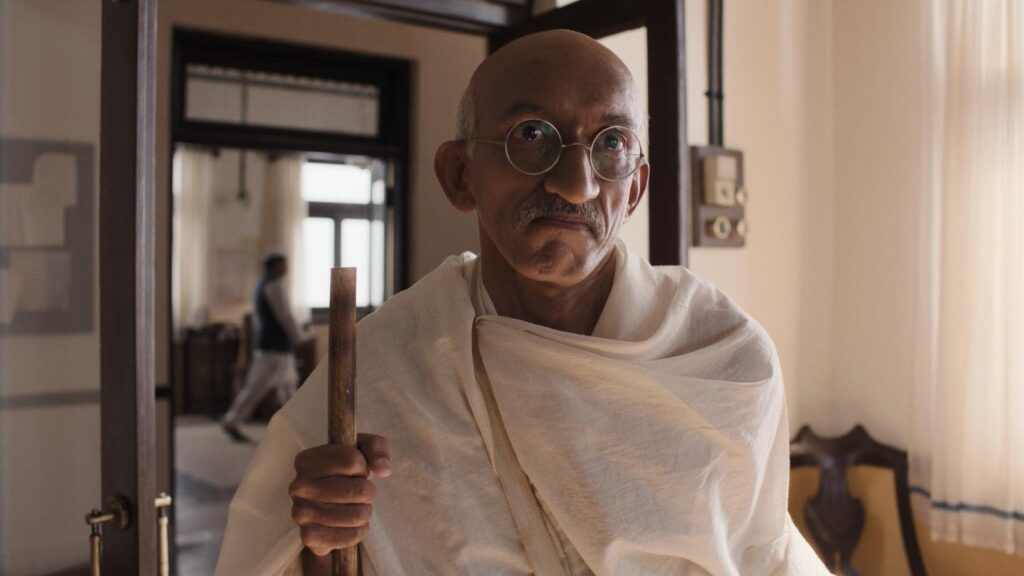
Freedom at Midnight Season 2 opens in July 1947, with BR Ambedkar presenting the tricolour to Congress members—a quiet moment bursting with symbolism. As Ambedkar explains the Ashok Chakra as the wheel of time that will move India forward, we witness idealism colliding with harsh reality. Maulana Azad’s admission that he assumed the colors represented religious communities, followed by Nehru’s powerful assertion that “Ek azaad, secular Hindustan ki pehchaan sirf insaaniyat hogi,” sets the stage for everything that follows.
The genius of Advani’s approach lies in presenting history as it unfolded—messy, painful, and irreversible. We see Cyril Radcliffe, a man who openly admits knowing nothing about India, tasked with drawing lines through Punjab and Bengal. Mountbatten’s chilling logic—that anyone who knows India would be biased—captures the colonial arrogance that shaped millions of destinies.
What makes this narrative extraordinary is its refusal to present easy villains. The moment Jinnah wakes to find his house being packed, when Fatima Jinnah tells him plainly that Pakistan’s Quaid-e-Azam cannot live in Bombay, we see personal loss within political upheaval. These aren’t textbook figures—they’re human beings making impossible choices.
Performances: Every Actor Delivers Career-Defining Work
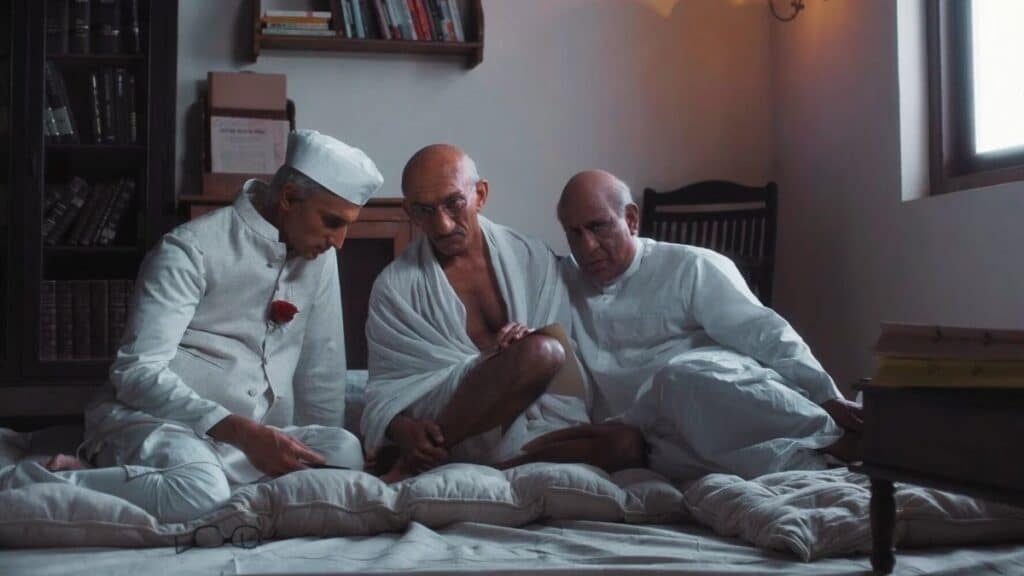
Siddhant Gupta: Becoming Nehru
This Freedom at Midnight Season 2 review must celebrate Siddhant Gupta’s extraordinary transformation. At just 36, he doesn’t merely play a 57-year-old Jawaharlal Nehru—he channels the leader’s idealism, political acumen, and internal conflicts with stunning authenticity. Watch him navigate the midnight Independence announcement, balancing religious leaders’ concerns about auspicious timing with his agnostic worldview, and you witness an actor completely inhabiting a historical icon.
Gupta captures Nehru’s posture, his measured speech patterns, even the way disappointment flickers across his face during confrontations with Jinnah. The “Tryst with Destiny” speech, woven seamlessly with archival footage, becomes genuinely moving because Gupta has earned that moment through episodes of nuanced character building.
Chirag Vohra: Gandhi’s Moral Compass
Chirag Vohra delivers the emotional spine of the entire series. His Gandhi carries the anguish of watching a lifelong dream splinter into communal violence. When he asks, “How do you divide pain soaked into the soil? How do you divide regret?”—you feel decades of non-violent struggle confronting its darkest outcome.
Vohra’s restraint is what makes his performance so powerful. There’s stubborn moral clarity in his eyes when Nehru and Patel ask him to attend Independence celebrations, a quiet devastation that speaks louder than any dramatic outburst. This Gandhi feels real—flawed, heartbroken, yet unwavering in his principles.
Arif Zakaria: Humanizing Jinnah
Arif Zakaria’s layered portrayal of Muhammad Ali Jinnah might be the series’ most courageous performance. He presents Jinnah not as a villain but as a complex man facing consequences he never fully anticipated. The scene where he admits to Nehru that violence was never his intention, only to hear Nehru respond that hatred once sown must be reaped by all, showcases two actors elevating material through sheer commitment to truth.
Zakaria’s face betrays loss even as Jinnah’s words maintain political composure. That restraint—letting emotion seep through silence—creates a portrait of tragic inevitability.
Rajendra Chawla: Patel’s Quiet Authority
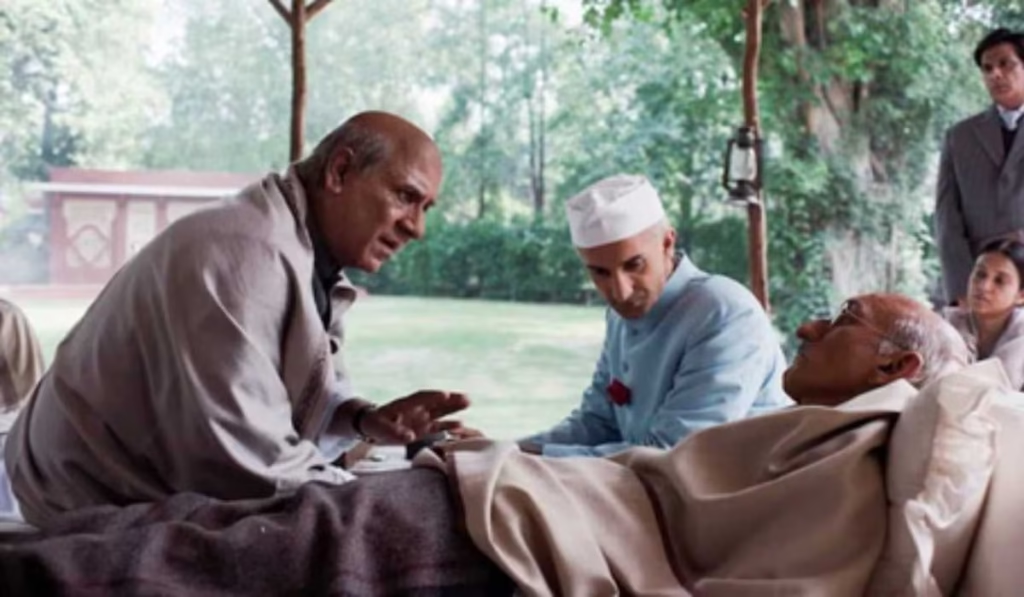
Rajendra Chawla brings Vallabhbhai Patel alive as the pragmatic counterbalance to Nehru’s idealism and Gandhi’s moral absolutism. His Patel stands silently observing during the tricolour presentation, and in that silence we read volumes—a man who believes in achievable solutions over philosophical debates.
Chawla’s performance reminds us that nation-building required different leadership styles, all equally essential. His decisive presence grounds the series whenever idealism threatens to float away from practical realities.
The Supporting Ensemble: Excellence Across the Board
Cordelia Bugeja and Luke McGibney are utterly convincing as Lady and Lord Mountbatten, capturing both colonial authority and the moral compromises of empire’s dying days. The supporting cast—from actors portraying Ambedkar to Maulana Azad—elevates every scene, proving that Malayalam cinema’s greatest strength has always been its depth of talent.
Direction and Vision: Advani’s Finest Work
Nikkhil Advani approaches Freedom at Midnight Season 2 with the confidence of a filmmaker who trusts his material completely. His decision to sit with history’s discomfort rather than smooth its rough edges demonstrates artistic maturity. The series never rushes toward Independence Day celebrations—it earns every moment by showing us the human cost behind political decisions.
Advani’s smartest choice is weaving original Independence footage seamlessly with dramatic recreation. When we hear “At the stroke of the midnight hour” within the narrative context, after watching everything that led there, it lands with emotional force no textbook could match.
The pacing allows critical moments to breathe. That opening tricolour presentation, border negotiation scenes with Radcliffe, Jinnah’s painful realization about leaving Bombay—these sequences receive the time they deserve. Advani understands that historical drama succeeds not through exposition but through allowing audiences to witness characters processing impossible realities.
Technical Brilliance: Craft Serving Story
Cinematography: Honoring Historical Gravity
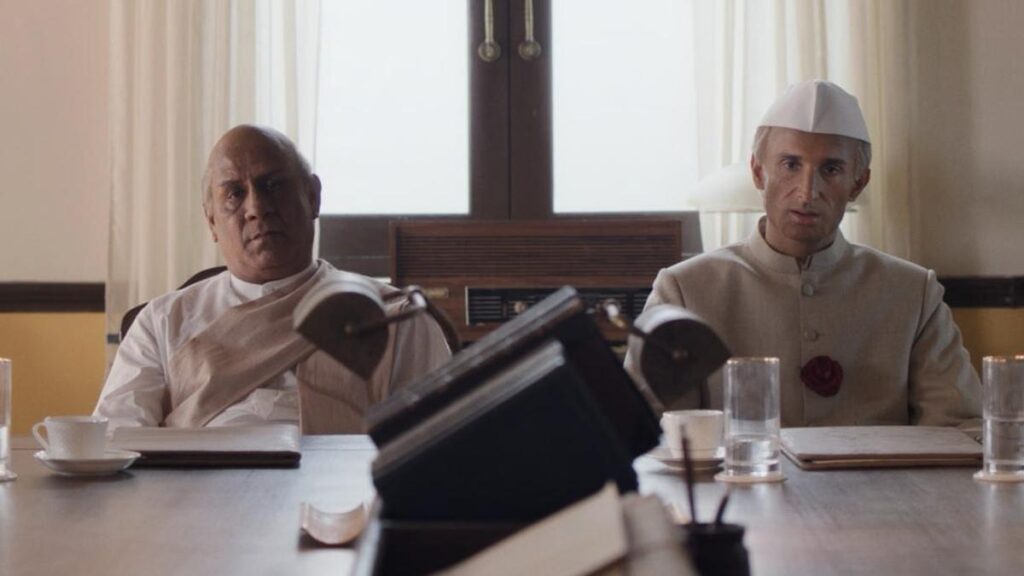
The visual language of Freedom at Midnight Season 2 demonstrates sophisticated restraint. Colors feel period-appropriate rather than Instagram-filtered. The strategic use of monochrome during partition violence sequences—trains packed with refugees mowed down by bullets, people carrying entire lives on their backs—lets horror speak without embellishment.
What’s particularly impressive is how the cinematography shifts between intimate character moments and epic historical sweep. The camera finds humanity in massive crowd scenes, then pulls back to show the overwhelming scale of displacement and violence.
Sound Design and Music: Emotional Resonance
The use of Amrita Pritam’s “Aaj Akhan Waris Shah Nu,” sung hauntingly by Sonam Kalra and Altamash Faridi, provides the series’ most devastating emotional moments. This isn’t background music—it’s a lament that captures partition’s soul-deep wounds.
The background score knows when to swell and when silence speaks louder. During confrontations between Nehru and Jinnah, quiet allows dialogue to carry full weight. During violence sequences, sound design creates visceral impact without exploitative excess.
Editing: Balancing Multiple Narratives
Keeping political maneuvering, personal tragedies, and historical events coherent across multiple episodes requires surgical editing. The series succeeds brilliantly, weaving Gandhi’s moral struggle, Nehru-Patel’s political negotiations, Jinnah’s painful choices, and Radcliffe’s impossible task into a unified narrative that maintains momentum while honoring complexity.
Cultural Impact: Essential Historical Understanding
This Freedom at Midnight Season 2 review must acknowledge the series’ educational value. For generations raised on simplified Independence narratives, seeing the messy reality—the compromises, the unintended consequences, the personal costs—provides crucial context for understanding contemporary India.
The series doesn’t preach but presents. When Nehru insists nothing will be decided based on religion while Patel looks on silently, we’re watching the foundations of secular India being laid alongside unspoken doubts. These nuances matter, especially in today’s political climate.
By laying groundwork for future seasons—political confrontations, negotiations with 500+ princely states, Gandhi’s assassination—the series positions itself as comprehensive historical documentation rather than isolated storytelling.
Strengths and What Could Improve
What Works Magnificently
- Extraordinary ensemble performances – Every actor delivers career-defining work that transcends impersonation
- Unflinching historical honesty – The series refuses to sanitize partition’s devastating reality
- Emotional depth without melodrama – Genuine feeling earned through character development
- Technical excellence – Cinematography, sound design, editing all serve the story beautifully
- Powerful use of poetry and music – Amrita Pritam’s “Aaj Akhan Waris Shah Nu” becomes emotional anchor
- Smart pacing – Allows critical moments to breathe while maintaining narrative momentum
Minor Room for Enhancement
- Certain Independence celebrations feel staged – Some jubilant moments lack the naturalism defining the rest of the series
- Could explore more regional perspectives – Deeper examination of how partition affected smaller communities would add layers
Final Verdict: 5/5 Stars ⭐⭐⭐⭐⭐
Freedom at Midnight Season 2 is essential viewing—not just for history enthusiasts but for anyone seeking to understand how India’s present was shaped by its painful birth. Nikkhil Advani has crafted a series that honors complexity, trusts its audience, and refuses to reduce partition to simple narratives.
This Freedom at Midnight Season 2 review celebrates filmmaking that matters. The performances alone—Siddhant Gupta’s transformative Nehru, Chirag Vohra’s heartbreaking Gandhi, Arif Zakaria’s humanized Jinnah, Rajendra Chawla’s pragmatic Patel—justify every minute of viewing time. But it’s the cumulative impact, the way personal stories illuminate historical forces, that makes this series genuinely special.
The series reminds us that freedom wasn’t a moment of celebration alone—it was fear, compromise, loss, and choices that still echo through Indian society today. By sitting with that discomfort, by showing us partition’s human cost without flinching, Freedom at Midnight Season 2 becomes more than entertainment. It becomes necessary viewing.
For those seeking historical drama that balances epic scope with intimate humanity, that trusts audiences with complexity, and that proves television can educate while profoundly moving—this is it. Stream it on SonyLiv not just to learn history, but to feel it, understand it, and carry its lessons forward.
Stream Freedom at Midnight Season 2 on SonyLiv now—this is history that demands to be witnessed, understood, and remembered.
