


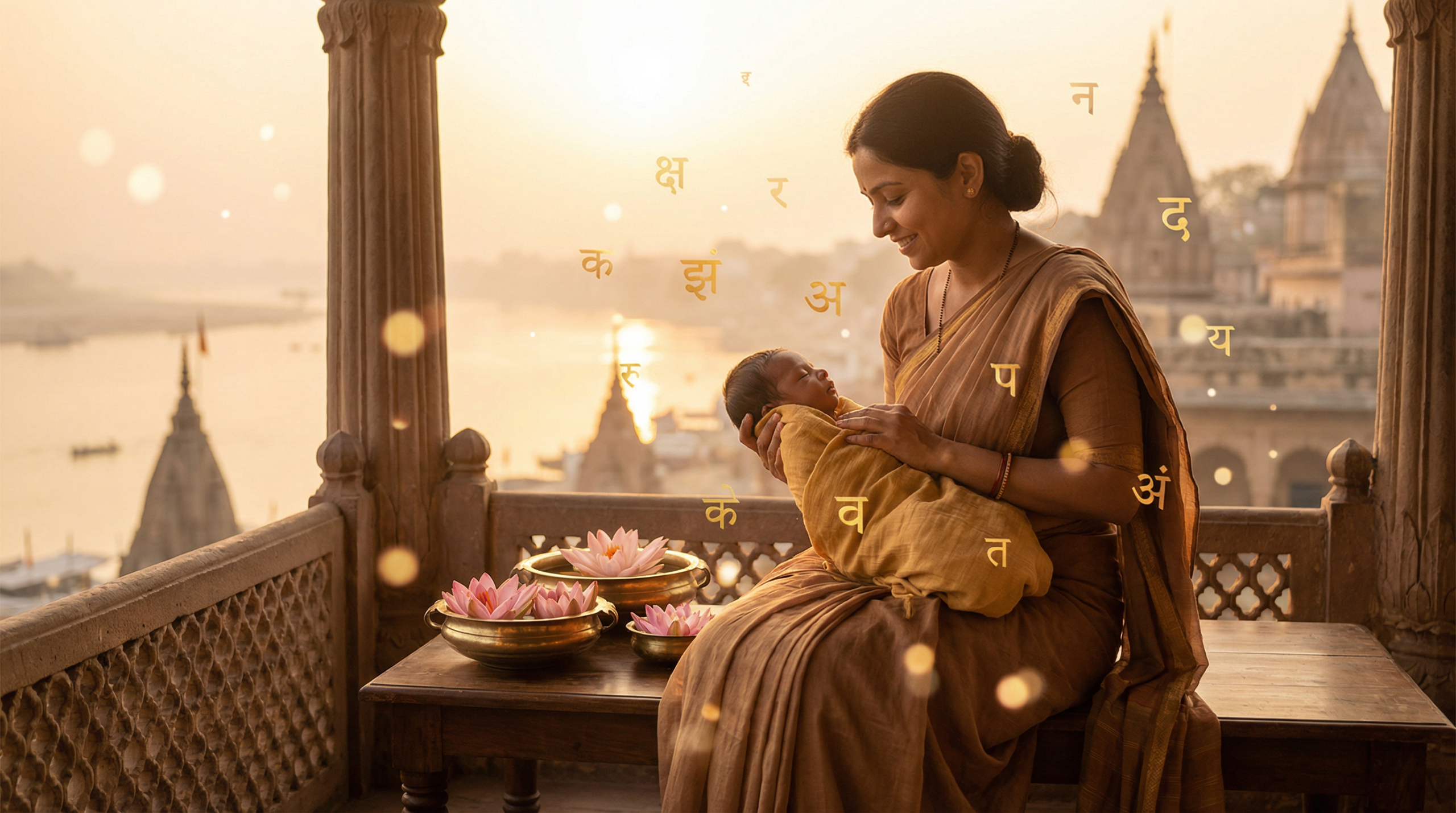
Why Sanskrit Baby Names Are Surging in 2026
Indian baby names in Sanskrit are having a remarkable moment in 2026 — and it is no coincidence. Across India and the Indian diaspora in the USA, UK, Canada, and Australia, parents are returning to the ancient language of the Vedas to find names that feel both timeless and fresh. Sanskrit names carry layers of meaning that modern coined names simply cannot match.
The trend is driven by two powerful forces. First, there is a global cultural pride movement: Indian parents everywhere are embracing heritage over assimilation. Second, Sanskrit names travel beautifully — they sound elegant in Mumbai, sound distinctive in Manhattan, and look impressive on a Harvard application. Names like Aarav, Vihaan, and Saanvi are already household words across Indian communities worldwide.
If you are expecting a baby in 2026, this guide gives you everything you need: trending names, rare gems, Devanagari script, meanings, Nakshatra alignment, and a step-by-step breakdown of the traditional Namkaran naming ceremony. Whether you are in Chennai or Chicago, this is your definitive resource for Indian baby names in Sanskrit 2026.
Why Choose a Sanskrit Name for Your 2026 Baby
Sanskrit names are not just names — they are complete blessings, encoded in the world’s oldest systematic language. Each name is a Sanskrit word with a precise, intentional meaning, making the act of naming your child a deeply conscious choice.
1. Cultural Heritage That Travels With Your Child
Sanskrit is the root of most Indian languages, including Hindi, Marathi, Bengali, Kannada, Telugu, and Malayalam. A Sanskrit name connects your child to an unbroken civilizational thread stretching back over 5,000 years. Whether your family is rooted in Rajasthan or recently relocated to New Jersey, that heritage travels with the name.
2. Universal, Melodic Sound
Sanskrit was designed as a phonetically perfect language — every syllable is deliberate. Names built from Sanskrit roots tend to be naturally musical: they flow off the tongue, avoid harsh consonant clusters, and sound equally good in Indian languages and in English. Names like Advait, Kavya, and Tejas prove that cultural depth and global appeal can coexist.
3. Deep, Purposeful Meaning
In Sanskrit naming philosophy, your name is not just a label — it is a daily affirmation. The name Dhruv (ध्रुव) means “the pole star,” anchoring the child to steadiness and purpose. Avani (अवनी) means “the earth,” grounding the child in nature and stability. Every syllable carries intention.
4. Astrological Compatibility
The Vedic tradition of Nakshatra-based naming means a Sanskrit name can be aligned with your baby’s birth star. This is a living tradition, practiced by families across all 29 states of India. Many Indian parents in the diaspora also consult a Jyotishi (Vedic astrologer) remotely before finalizing their child’s name.
5. Global-Friendly Pronunciation
Sanskrit names are increasingly popular with non-Indian communities because of their clear, vowel-rich phonetics. Names like Aarav, Tara, Rohan, and Maya have crossed cultural borders effortlessly. For diaspora families, this is a huge practical advantage: your child will not spend their life correcting mispronunciations.
6. Timeless Quality — Never Goes Out of Style
Trendy names age. Sanskrit names do not. Arjun has been a beloved name for three millennia. Meera has been sung in devotional poetry for centuries. Choosing a Sanskrit name means choosing something that will still feel dignified when your child is 40, 60, or 80 years old.
How Sanskrit Names Are Chosen: The Vedic Tradition
In the Vedic tradition, naming a child is a sacred ritual guided by astrology, religious scripture, and family lineage. The name is not chosen casually — it is calculated, consulted upon, and ceremonially bestowed during the Namkaran (नामकरण) ceremony.
The Nakshatra System: Your Baby’s Birth Star
The most important factor in traditional Vedic naming is the baby’s Janma Nakshatra — the lunar mansion (star constellation) that the Moon occupied at the exact moment of birth. There are 27 Nakshatras in total, and each one is associated with specific syllables called Aksharas or Swars. A child named with a syllable matching their Nakshatra is believed to receive cosmic harmony throughout their life.
For example, a baby born under Rohini Nakshatra would receive a name beginning with O, Va, Vi, or Vu. A child born under Ashwini Nakshatra would receive a name starting with Chu, Che, Cho, or La. The Nakshatra is determined by the Janma Kundli (birth chart), which is drawn up by a Jyotishi — a trained Vedic astrologer.
Rashi: The Moon Sign
Beyond the Nakshatra, many families also consider the baby’s Rashi — the zodiac sign of the Moon at birth. There are 12 Rashis in Vedic astrology, each associated with specific letters and name sounds. Rashi-based naming is especially common in Maharashtra, Gujarat, and among South Indian Tamil Brahmin families.
The Role of the Jyotishi
A Jyotishi (Vedic astrologer/priest) prepares the child’s birth chart using the exact time, date, and location of birth. They then recommend an auspicious starting syllable for the name. In the diaspora, many families consult a Jyotishi via video call or email, sending the birth details and receiving a list of recommended name-starting sounds. This practice remains alive and well among Indian families from New York to Nairobi.
Other Naming Traditions
Beyond astrology, some Sanskrit names are chosen based on:
- Gotra — the family’s ancestral lineage or clan, which may carry naming conventions
- Deity devotion — naming the child after a beloved god or goddess (Krishnapriya, Shivansh, Saraswati)
- Ancestors — honoring grandparents or great-grandparents by carrying forward a variation of their name
- Virtue or aspiration — choosing a name that embodies what parents wish for their child (Dhairya = courage, Pragya = wisdom)
Top 30 Sanskrit Baby Boy Names for 2026
These are the best Sanskrit baby boy names for 2026 — a curated blend of trending favorites that Indian parents love right now and rare, distinctive gems that are gaining momentum. Every name below includes its Devanagari script, meaning, and a one-line cultural note.
Trending Sanskrit Boy Names
- Aarav (आरव) — Meaning: peaceful, melodious sound | India’s #1 boys’ name for several years running; warm and easy to pronounce globally.
- Vihaan (विहान) — Meaning: dawn, the first light of a new era | Rising fast across India and the diaspora; feels optimistic and modern.
- Reyansh (रेयांश) — Meaning: a part of Lord Vishnu’s divine light | One of the fastest-growing names in 2024–2026; strong spiritual energy.
- Advait (अद्वैत) — Meaning: unique, non-dual, the philosophy of Advaita Vedanta | Carries deep philosophical weight; beloved by educated urban families.
- Atharv (अथर्व) — Meaning: first Vedas, Lord Ganesha, knowledge | A name that evokes the sacred Atharva Veda; intellectually rich.
- Vivaan (विवान) — Meaning: full of life, rays of the morning sun | Bright, energetic, and globally accessible.
- Dhruv (ध्रुव) — Meaning: the pole star, immovable, constant | Classic Sanskrit name with enduring strength; both traditional and fresh.
- Arjun (अर्जुन) — Meaning: bright, shining, white, clear | Mahabharata’s greatest warrior; powerful yet poetic.
- Tejas (तेजस) — Meaning: brilliance, radiance, sharpness | A name that speaks of fire and intelligence; popular in Maharashtra and Karnataka.
- Pranav (प्रणव) — Meaning: the sacred sound Om, the primordial vibration | Spiritually profound; simple to pronounce in any language.
- Rudra (रुद्र) — Meaning: the roarer, a fierce form of Lord Shiva | Bold and powerful; rising in popularity among families who want strength in a name.
- Sarthak (सार्थक) — Meaning: meaningful, purposeful, worthwhile | A name that is itself a life philosophy; popular in North India.
- Ojas (ओजस) — Meaning: vital energy, lustre, body strength | Rooted in Ayurvedic philosophy; rare enough to stand out, recognizable enough to land well.
- Parth (पार्थ) — Meaning: son of Pritha (Kunti), another name for Arjun | Elegant short form with mythological weight; works well in the West.
- Kian (कियान) — Meaning: ancient, full of grace and wisdom | Bridges Sanskrit and global name trends effortlessly.
- Kabir (कबीर) — Meaning: great, powerful, noble | Also the name of the beloved 15th-century poet-saint; cross-cultural and dignified.
- Ishan (ईशान) — Meaning: the northeast direction, Lord Shiva, the sun | Deeply rooted in Vedic cosmology; sounds contemporary.
- Shaurya (शौर्य) — Meaning: bravery, heroism, valor | A warrior name for the modern era; popular across India.
- Naksh (नक्श) — Meaning: the moon, features, outline | Short, striking, and deeply Sanskrit in origin; a rising gem.
- Arnav (अर्णव) — Meaning: ocean, sea, flowing water | Evokes vast horizons; popular with families who love nature-based names.
Rare & Unique Sanskrit Boy Names for 2026
- Agastya (अगस्त्य) — Meaning: mountain thrower, a celebrated Vedic sage | One of the Saptarishis (seven great sages); rare and deeply rooted in Sanskrit tradition.
- Amogha (अमोघ) — Meaning: infallible, unerring, never in vain | A name of Lord Vishnu; powerful and uncommon.
- Chaitanya (चैतन्य) — Meaning: consciousness, divine energy, life force | Also the name of a great 15th-century saint; spiritual and distinctive.
- Eshan (ईशान) — Meaning: desiring, wishing; another name for Lord Shiva | Softer and rarer than Ishan; beautiful sound.
- Nirvaan (निर्वाण) — Meaning: liberation, ultimate bliss, the highest state of peace | Buddhist and Vedic in origin; a transcendent choice for 2026.
- Saurav (सौरव) — Meaning: divine fragrance, celestial perfume | Evokes beauty and subtlety; uncommon in younger generations.
- Ujjwal (उज्ज्वल) — Meaning: bright, luminous, resplendent | A luminous name that is not overused; strong North Indian roots.
- Vasant (वसंत) — Meaning: spring season, new beginnings, bloom | Nature-rooted and poetic; a name that carries warmth.
- Yuvaan (युवान) — Meaning: young, youthful, energetic | Rare form of Yuvan; fresh and vigorous.
- Daksh (दक्ष) — Meaning: able, skilled, talented, competent | A name that sets high expectations in the most beautiful way; used in Vedic literature.
Top 30 Sanskrit Baby Girl Names for 2026
The best Sanskrit baby girl names for 2026 are a blend of graceful trending choices and rare, soul-stirring gems drawn from Vedic texts and Sanskrit literature. Each name below is complete with Devanagari script, its meaning, and a brief note on why it resonates today.
Trending Sanskrit Girl Names
- Aaradhya (आराध्या) — Meaning: worthy of worship, devotion | Hugely popular since Amitabh Bachchan’s granddaughter made it famous; deeply spiritual.
- Ananya (अनन्या) — Meaning: unique, one-of-a-kind, incomparable | Captures everything parents want their daughter to be; consistently in India’s top 10.
- Avani (अवनी) — Meaning: the earth, ground, nature | Grounded, beautiful, and globally pronounceable; a favorite across India.
- Kavya (काव्या) — Meaning: poetry, poetic beauty, the art of verse | A name that is itself a piece of art; strong in South India and the diaspora.
- Saanvi (सान्वी) — Meaning: Goddess Lakshmi, one who will be followed | One of the top girls’ names in India for 2024–2026; auspicious and melodic.
- Anika (अनिका) — Meaning: grace, brilliance, the face of the army | Short, elegant, and works perfectly in Western contexts too.
- Ishita (इशिता) — Meaning: mastery, supremacy, one who desires | A name of quiet power; beloved in Bengal and across urban India.
- Navya (नव्या) — Meaning: new, young, worth praising | Embodies freshness and modernity while being rooted in Sanskrit.
- Riya (रिया) — Meaning: a singer, graceful, gem | Simple, sweet, and perfectly global; a perennial diaspora favorite.
- Shruti (श्रुति) — Meaning: musical notes, that which is heard, sacred scripture | Connects the child to both music and the Vedic oral tradition.
- Tanvi (तन्वी) — Meaning: slender, delicate, beautiful | A classic Sanskrit name with an elegant, feminine sound.
- Vanya (वान्या) — Meaning: gracious gift of God, belonging to the forest | Feels both global and deeply Sanskrit; rising in the diaspora.
- Kiara (कियारा) — Meaning: bright, clear, famous | Bridges Western and Sanskrit worlds; fashionable without being fleeting.
- Ahana (अहाना) — Meaning: inner light, dawn, one who cannot be destroyed | Lyrical and rare enough to feel special; Sanskrit roots run deep.
- Aadya (आद्या) — Meaning: the first, the primal power, Goddess Durga | A name of cosmic significance; the first name in the Sanskrit alphabet tradition.
- Dhriti (धृति) — Meaning: courage, will power, steadiness | A virtue name that gives a girl a lifelong anchor; underused and beautiful.
- Esha (ईशा) — Meaning: desire, wish, Goddess Parvati | Short, strong, globally friendly; one of the cleanest Sanskrit names for global use.
- Riddhi (ऋद्धि) — Meaning: prosperity, growth, good fortune | Associated with Goddess Riddhi, consort of Lord Ganesha; auspicious and warm.
- Trisha (त्रिशा) — Meaning: thirst, desire, wish; also a form of Goddess Durga | A name that has travelled beautifully into Western consciousness.
- Meera (मीरा) — Meaning: devotee, prosperous, ocean | The name of the great bhakti poet-saint Mirabai; timelessly beautiful.
Rare & Unique Sanskrit Girl Names for 2026
- Akshara (अक्षरा) — Meaning: imperishable, letter, syllable; the sacred written word | In Sanskrit, Akshara means both a syllable and the eternal — a poetic choice for a language-lover’s daughter.
- Arundhati (अरुन्धती) — Meaning: the star Alcor, the devoted wife of sage Vasishtha | One of the most sacred names in Hindu tradition; rare and deeply meaningful.
- Chitra (चित्रा) — Meaning: a picture, brilliant, variegated | Also the name of a Nakshatra; artistic and evocative.
- Gargi (गार्गी) — Meaning: a female philosopher, daughter of Garga | One of India’s first intellectual women, celebrated in the Brihadaranyaka Upanishad; powerful and scholarly.
- Jivika (जीविका) — Meaning: source of life, water, livelihood | A quietly profound name; rare in modern usage but rich in Sanskrit heritage.
- Mandira (मन्दिरा) — Meaning: a home, temple, abode of the divine | Soft and sacred; evokes shelter and sanctity.
- Niranjana (निरंजना) — Meaning: the pure one, one who is unstained, Goddess Durga | A name of luminous purity; long but worth every syllable.
- Shailja (शैलजा) — Meaning: daughter of the mountain, Goddess Parvati | Rare, poetic, and deeply connected to the feminine divine in Sanskrit tradition.
- Uttara (उत्तरा) — Meaning: the north star, a Nakshatra, the daughter of King Virata in the Mahabharata | Rare and mythologically rich; a genuine gem.
- Vasudha (वसुधा) — Meaning: the earth, the bearer of wealth | One of the most beautiful Sanskrit names for the earth; grounding, dignified, and uncommon.
Structured Comparison Table: Top 20 Boys & Girls Sanskrit Names for 2026
Use this quick-reference table to compare the top Sanskrit names side by side. Each entry lists the name, its Devanagari script, core meaning, associated Rashi (zodiac), and overall vibe — so you can find the perfect match for your baby’s personality before they even arrive.
Top 20 Sanskrit Baby Boy Names — Quick Reference
| Name | Sanskrit Script | Meaning | Rashi / Vibe |
|---|---|---|---|
| Aarav | आरव | Peaceful, melodious sound | Mesh (Aries) / Calm & Musical |
| Vihaan | विहान | Dawn, first light of a new era | Vrishabh (Taurus) / Bright & Hopeful |
| Advait | अद्वैत | Unique, non-dual (Advaita philosophy) | Kanya (Virgo) / Philosophical & Deep |
| Atharv | अथर्व | The Vedas, Lord Ganesha, knowledge | Simha (Leo) / Wise & Scholarly |
| Dhruv | ध्रुव | Pole star, constant, immovable | Makar (Capricorn) / Steadfast & Reliable |
| Tejas | तेजस | Brilliance, radiance, sharpness | Mesh (Aries) / Fiery & Luminous |
| Pranav | प्रणव | The sacred sound Om, primordial vibration | Kumbh (Aquarius) / Spiritual & Serene |
| Rudra | रुद्र | Fierce form of Shiva, the roarer | Vrishchik (Scorpio) / Bold & Powerful |
| Ojas | ओजस | Vital energy, lustre, strength | Simha (Leo) / Energetic & Vibrant |
| Parth | पार्थ | Son of Pritha, name of Arjun | Dhanu (Sagittarius) / Noble & Heroic |
| Shaurya | शौर्य | Bravery, heroism, valor | Mesh (Aries) / Courageous & Dynamic |
| Arnav | अर्णव | Ocean, sea, vast flowing water | Meen (Pisces) / Expansive & Calm |
| Agastya | अगस्त्य | Great Vedic sage, mountain mover | Kanya (Virgo) / Wise & Distinguished |
| Chaitanya | चैतन्य | Consciousness, divine energy, life force | Mithun (Gemini) / Spiritual & Lively |
| Daksh | दक्ष | Skilled, talented, competent | Vrishabh (Taurus) / Capable & Sharp |
| Ishan | ईशान | Northeast direction, Lord Shiva, the sun | Mesh (Aries) / Divine & Radiant |
| Kabir | कबीर | Great, noble, powerful | Vrishchik (Scorpio) / Poetic & Dignified |
| Reyansh | रेयांश | Ray of God’s divine light (Vishnu) | Simha (Leo) / Luminous & Spiritual |
| Ujjwal | उज्ज्वल | Bright, luminous, resplendent | Karka (Cancer) / Radiant & Warm |
| Vasant | वसंत | Spring season, new beginnings | Mithun (Gemini) / Fresh & Joyful |
Top 20 Sanskrit Baby Girl Names — Quick Reference
| Name | Sanskrit Script | Meaning | Rashi / Vibe |
|---|---|---|---|
| Aaradhya | आराध्या | Worthy of worship, devotion | Vrishabh (Taurus) / Devout & Graceful |
| Ananya | अनन्या | Unique, incomparable, one-of-a-kind | Kanya (Virgo) / Confident & Radiant |
| Avani | अवनी | The earth, nature, ground | Vrishabh (Taurus) / Grounded & Serene |
| Kavya | काव्या | Poetry, poetic beauty | Mithun (Gemini) / Artistic & Expressive |
| Saanvi | सान्वी | Goddess Lakshmi, one who will be followed | Tula (Libra) / Auspicious & Sweet |
| Aadya | आद्या | The first power, Goddess Durga | Mesh (Aries) / Powerful & Primal |
| Ahana | अहाना | Inner light, dawn, indestructible | Simha (Leo) / Luminous & Unique |
| Dhriti | धृति | Courage, willpower, steadiness | Makar (Capricorn) / Strong & Determined |
| Esha | ईशा | Desire, Goddess Parvati | Mesh (Aries) / Bold & Elegant |
| Meera | मीरा | Devotee, prosperous, ocean | Meen (Pisces) / Devotional & Timeless |
| Navya | नव्या | New, young, worth praising | Mithun (Gemini) / Fresh & Modern |
| Riddhi | ऋद्धि | Prosperity, good fortune, growth | Vrishabh (Taurus) / Auspicious & Warm |
| Shruti | श्रुति | Sacred scripture heard, musical notes | Kanya (Virgo) / Melodic & Scholarly |
| Akshara | अक्षरा | Imperishable, the sacred syllable | Kanya (Virgo) / Intellectual & Pure |
| Arundhati | अरुन्धती | The star Alcor, the devoted one | Makar (Capricorn) / Rare & Sacred |
| Chitra | चित्रा | Brilliant, a picture, variegated | Tula (Libra) / Artistic & Vivid |
| Gargi | गार्गी | Vedic philosopher, daughter of Garga | Kanya (Virgo) / Scholarly & Powerful |
| Jivika | जीविका | Source of life, water, livelihood | Karka (Cancer) / Nurturing & Vital |
| Shailja | शैलजा | Daughter of the mountain, Parvati | Vrishabh (Taurus) / Divine & Elegant |
| Vasudha | वसुधा | The earth, bearer of all wealth | Vrishabh (Taurus) / Grounded & Majestic |
Sanskrit Names by Meaning Category
One of the most useful ways to choose a Sanskrit name is to start with a meaning — a quality or element you want your child to embody. Here are the top Sanskrit baby names grouped by their core meaning, so you can find names that align with your vision for your child’s life.
Names Meaning Light, Sun & Radiance
These names carry the energy of the sun, fire, and luminosity — perfect for a child you hope will illuminate the world around them.
- Tejas (तेजस) — radiance, brilliance (boy)
- Reyansh (रेयांश) — ray of divine light (boy)
- Ujjwal (उज्ज्वल) — bright and luminous (boy)
- Ahana (अहाना) — inner light, dawn (girl)
- Diya (दिया) — a lamp, divine light (girl)
- Kiran (किरण) — ray of sunlight (boy/girl)
- Aditya (आदित्य) — the sun, son of Aditi (boy)
- Jyoti (ज्योति) — flame, light (girl)
Names Meaning Knowledge & Wisdom
Rooted in the Vedic reverence for learning, these names honor the life of the mind and the pursuit of truth.
- Pragya (प्रज्ञा) — wisdom, intelligence (girl)
- Atharv (अथर्व) — knowledge, the Vedas (boy)
- Vidya (विद्या) — knowledge, learning (girl)
- Bodhi (बोधि) — awakened, enlightened (boy)
- Gargi (गार्गी) — Vedic philosopher (girl)
- Vivek (विवेक) — discernment, wisdom (boy)
- Dhiman (धीमान) — knowledgeable, wise (boy)
Names Meaning Nature: Earth, Water & Sky
Sanskrit is the language of nature — the Vedas are filled with hymns to rivers, mountains, and stars. These names bring the natural world into your child’s identity.
- Avani (अवनी) — the earth (girl)
- Vasudha (वसुधा) — the earth, bearer of wealth (girl)
- Arnav (अर्णव) — ocean, sea (boy)
- Vasant (वसंत) — spring (boy)
- Vanya (वान्या) — of the forest (girl)
- Akash (आकाश) — the sky (boy)
- Nadia (नदी) — river (girl)
- Arundhati (अरुन्धती) — star, the star Alcor (girl)
Names Meaning Victory, Power & Strength
These names carry warrior energy — they are names that prepare a child to face life’s challenges with grace and determination.
- Shaurya (शौर्य) — bravery, valor (boy)
- Rudra (रुद्र) — fierce, powerful (boy)
- Dhriti (धृति) — steadiness, willpower (girl)
- Daksh (दक्ष) — capable, skilled (boy)
- Jaya (जया) — victory (girl)
- Vijay (विजय) — victory, conqueror (boy)
- Aadya (आद्या) — primal power, Durga (girl)
- Ojas (ओजस) — vital energy, strength (boy)
Names Meaning Divine & Spiritual
For families who want to honour the divine in their child’s name — connecting them from birth to the sacred.
- Pranav (प्रणव) — the sound Om (boy)
- Aaradhya (आराध्या) — worthy of worship (girl)
- Chaitanya (चैतन्य) — divine consciousness (boy)
- Meera (मीरा) — devotee of Krishna (girl)
- Ishan (ईशान) — Lord Shiva, the divine direction (boy)
- Nirvaan (निर्वाण) — ultimate liberation, bliss (boy)
- Niranjana (निरंजना) — pure, unstained (girl)
- Amogha (अमोघ) — infallible, name of Vishnu (boy)
Sanskrit Baby Names for the Indian Diaspora
For Indian families raising children in the USA, UK, Canada, or Australia, the right Sanskrit name serves a double purpose: it honours cultural heritage at home and travels with ease in a multicultural world. The best diaspora-friendly Sanskrit names share three qualities — they are phonetically clear, easy to spell approximately as they sound, and free of sounds that English speakers typically stumble over.
What Makes a Sanskrit Name “Globally Friendly”?
- Avoids the retroflex consonants (ट, ठ, ड, ढ) that are difficult to produce in English
- Three syllables or fewer — short names survive the school roll-call test
- Vowel sounds familiar to English speakers (a, e, i, o, u)
- Clear stress pattern — doesn’t rely on tonal distinctions
Top Diaspora-Friendly Sanskrit Boy Names
- Aarav (आरव) — Two syllables, melodic, already recognised globally
- Rohan (रोहन) — Meaning “ascending”; common in Ireland too, making it a true cross-cultural name
- Arjun (अर्जुन) — Three clear syllables; widely recognised through Bollywood and literature
- Dhruv (ध्रुव) — Single compound syllable; sounds strong and simple anywhere
- Kiran (किरण) — Meaning “ray of light”; unisex, two syllables, universally pronounceable
- Vivaan (विवान) — Energetic, three syllables, flows naturally in English sentences
- Neil / Neel (नील) — Meaning “sapphire blue”; also an English name, making it seamless
- Parth (पार्थ) — One syllable core, mythological depth, easy for any teacher
- Kabir (कबीर) — Known globally through Sufi and bhakti traditions; elegant everywhere
- Tejas (तेजस) — Meaning “brilliance”; phonetically clean, memorable
Top Diaspora-Friendly Sanskrit Girl Names
- Ananya (अनन्या) — Four clear syllables; beautiful and pronounceable in any accent
- Esha (ईशा) — Two syllables, rhymes naturally with Western names like Aisha
- Riya (रिया) — Two syllables; sounds similar to the Spanish/Western name Ria
- Kavya (काव्या) — Two syllables; the “v” and “ya” ending make it distinctive yet easy
- Anika (अनिका) — Three syllables; already popular in Scandinavian countries too
- Meera (मीरा) — Two syllables; known globally through the bhakti saint; effortless anywhere
- Tara (तारा) — Two syllables; also a common name in Ireland and Celtic traditions
- Maya (माया) — Two syllables; meaning “illusion/magic”; beloved across many cultures
- Avani (अवनी) — Three syllables; clear vowel-forward sounds; easy to learn
- Vanya (वान्या) — Two syllables; sounds familiar to Eastern European ears (Vanya) yet is purely Sanskrit in origin
A Practical Tip for Diaspora Families
Consider your child’s full name as a system — first name, middle name, and surname together. Many diaspora families choose a deeply traditional Sanskrit name as the first name, with a shorter, globally accessible name as a “used name” or nickname. For example, Arundhati at home becomes Aru at school. Chaitanya becomes Chai. This approach preserves cultural depth without creating daily friction.
Sanskrit Names to Reconsider in 2026
Choosing a name is also about choosing how your child will stand out — or blend in. Some Sanskrit names have become so popular that they have lost their distinctiveness, while others present challenges for global use. This section is meant to inform, not criticise — every name here is beautiful and valid.
Names That Have Reached Saturation Point
These names are beloved for good reason, but their sheer popularity in 2024–2026 means your child may share their name with three classmates. If uniqueness matters to your family, you might consider rarer alternatives.
- Aarav — Still the most popular Indian boys’ name; your son will likely meet several Aaravs growing up
- Arjun — A timeless classic, but now so common it has become the “John” of Indian boys’ names
- Priya — Meaning “beloved”; beautiful, but extremely common across all generations
- Ananya — Hugely popular among girls born 2018–2026; no longer feels rare
- Aaradhya — Celebrity association has made this overwhelmingly popular in the past decade
- Saanvi — A lovely name, but now ranking #1 or #2 for girls in several Indian states
Alternative approach: If you love these names but want something fresher, look for meaningful variations — Aarush instead of Aarav, Parth instead of Arjun, Prerna instead of Priya.
Names With Global Pronunciation Challenges
These names are beautiful in Sanskrit but can create consistent mispronunciation issues for children in Western schools and workplaces. This does not mean you should not use them — simply be prepared for this reality, and consider whether a nickname system will help.
- Shreyansh — The “shrey” cluster is difficult for English speakers; often mangled to “Shren” or “Shreen”
- Vrushabh — The “vr” onset is unique to Sanskrit/Hindi; Western speakers will approximate awkwardly
- Dnyaneshwar — A magnificent Maharashtrian name, but the “dn” onset is unfamiliar globally
- Purushottam — Six syllables; even within India, nicknames (Puru, Puru) inevitably take over
The goal is not to abandon Sanskrit richness — it is to give your child a name they can carry with confidence in every room they walk into.
Namkaran: How to Perform the Baby Naming Ceremony
The Namkaran (नामकरण) ceremony is one of the sixteen Samskaras (sacred rites of passage) in Hinduism. The word itself tells you everything: naam (name) + karan (to create). This is not just a party — it is the formal, spiritual introduction of your child to the world and to the cosmos.
When Is Namkaran Performed?
Traditionally, Namkaran is performed on the 11th or 12th day after birth — after the mother’s postpartum purification period (Sutika kala) ends. If that timing is not possible, the ceremony can be performed on any auspicious day within the first 100 days, or before the child’s first birthday. The exact date should be confirmed with a priest or Jyotishi based on the family’s Panchang (Hindu almanac).
Step-by-Step: The Namkaran Ceremony
- Consult a Jyotishi: Share the baby’s exact birth date, time, and location. The Jyotishi prepares the Janma Kundli (birth chart) and determines the auspicious starting syllable for the name based on the Janma Nakshatra.
- Choose an Auspicious Date (Muhurta): Using the Panchang, a priest identifies a favorable date and time for the ceremony. Avoid inauspicious periods like Rahu Kaal.
- Purification and Preparation: The home is cleaned. A sacred altar (puja sthan) is set up with flowers, incense, lamps (diyas), and a havan kund (fire pit) if a full Havan ceremony is being performed.
- Havan Poojan: The parents perform a fire ritual (Havan or Agni puja), offering ghee, sesame seeds, and sacred herbs to the fire while chanting Vedic mantras. This purifies the space and invokes divine blessings for the child.
- Writing the Name: The father writes the chosen name on a bronze plate or silver tray filled with raw rice grains — sometimes using a gold ring as the writing instrument. This symbolically anchors the name in the material world.
- Whispering the Name: The father whispers the baby’s name four times into the child’s right ear, beginning the energetic imprinting of the name.
- Formal Announcement: The priest formally announces the name to the assembled family and guests. The mother then whispers the name into the baby’s left ear.
- Blessings and Feast: Guests bless the baby by name. Gifts are exchanged, and the family hosts a celebratory meal with traditional sweets and dishes.
Namkaran for Diaspora Families
If you are outside India, you have several good options. Many Indian priests in diaspora communities — in Temples across the USA, UK, Canada, and Australia — perform Namkaran ceremonies. Alternatively, you can organize a simplified home ceremony with a pandits available remotely via video call to chant the mantras and guide the ritual in real time. The essence of the ceremony — the intention, the community, and the sacred naming — remains fully intact regardless of geography.
What to Name Your Child Before the Ceremony?
In many families, a Daak naam (pet name or call name) is used in the first weeks of life before the formal name is announced. This is a warm tradition — the baby is known by a sweet, informal name within the household until Namkaran day, when the official Sanskrit name is bestowed.
Frequently Asked Questions About Sanskrit Baby Names 2026
What are the most popular Sanskrit baby names in 2026?
The most popular Sanskrit baby boy names in 2026 include Aarav (आरव), Vihaan (विहान), Reyansh (रेयांश), Advait (अद्वैत), and Atharv (अथर्व). For girls, Saanvi (सान्वी), Ananya (अनन्या), Aaradhya (आराध्या), Avani (अवनी), and Aadya (आद्या) consistently top the charts. These names combine deep Sanskrit meaning with a modern, globally accessible sound that Indian parents in India and abroad love.
What does “Sanskrit” mean in a baby name?
A Sanskrit baby name is a name derived from the ancient Sanskrit language — one of the world’s oldest and most systematically structured languages, dating back over 4,000 years. Sanskrit is the sacred language of Hinduism, Buddhism, and Jainism, and is the root of most major Indian languages. Every Sanskrit word carries a precise, intentional meaning, so Sanskrit baby names are never arbitrary — they are complete blessings, virtues, or descriptions encoded in a single word.
How do I choose a Sanskrit name based on my baby’s nakshatra?
To choose a name based on your baby’s Nakshatra, you need three pieces of information: your baby’s exact birth date, birth time, and birth location. From these, a Jyotishi (Vedic astrologer) or online Panchang calculator can determine the Janma Nakshatra — the lunar mansion the Moon occupied at birth. Each of the 27 Nakshatras is associated with specific starting syllables (called Aksharas or Swars). For example, a baby born under Rohini Nakshatra would receive a name starting with O, Va, Vi, or Vu. Once you have the recommended syllable, choose a meaningful Sanskrit name that begins with it.
Are Sanskrit names good for Indian babies growing up in the USA?
Yes — Sanskrit names are an excellent choice for Indian children in the USA, and increasingly for non-Indian families too. The key is to choose names that are phonetically accessible to English speakers. Names like Aarav, Arjun, Riya, Esha, Kabir, Maya, Tara, and Kavya work beautifully in both Indian and American contexts. They carry rich cultural meaning while being easy to pronounce, spell approximately correctly, and remember. For the Indian diaspora, a Sanskrit name gives your child a rooted identity and a strong cultural anchor in a multicultural environment.
What is the most unique Sanskrit baby name for 2026?
For boys, the most unique Sanskrit names for 2026 include Amogha (अमोघ, meaning infallible), Agastya (अगस्त्य, the great sage), and Vasant (वसंत, spring). For girls, Gargi (गार्गी, the Vedic philosopher), Arundhati (अरुन्धती, the sacred star), and Vasudha (वसुधा, the earth) are rare, deeply meaningful, and virtually unused by today’s parents — making them genuinely unique choices that will set your child apart.
What is the difference between a Hindu name and a Sanskrit name?
A Sanskrit name is a name derived specifically from the Sanskrit language. A Hindu name is a name given to a baby in the Hindu religious tradition, which may or may not be from Sanskrit. Most Hindu names are Sanskrit in origin, but some Hindu names come from regional Indian languages like Tamil, Telugu, Marathi, or Punjabi. Conversely, many Sanskrit names are used by Buddhist and Jain families who are not Hindu. The terms often overlap, but they are not identical: Sanskrit refers to the language of origin, while Hindu refers to the religious tradition of naming.
What is the Namkaran ceremony?
The Namkaran (नामकरण) ceremony is the Hindu baby naming ritual — one of the sixteen sacred Samskaras (rites of passage) in the Vedic tradition. The word Namkaran combines the Sanskrit words for “name” (naam) and “to create” (karan). The ceremony is traditionally performed on the 11th or 12th day after birth. It involves a fire ritual (Havan), the writing of the baby’s name in rice grains, and the father whispering the name four times into the baby’s right ear before formally announcing it to family and guests. It is a deeply spiritual occasion that also marks the mother’s return to the household after the postpartum rest period.
Which Sanskrit names are easiest to pronounce for Western speakers?
The Sanskrit names easiest for Western speakers to pronounce are those with clear vowel sounds, two to three syllables, and no retroflex consonants. The best options include: Aarav, Rohan, Arjun, Kiran, Neil (Neel), Kabir, Parth, Tejas for boys, and Riya, Maya, Tara, Esha, Anika, Meera, Kavya, Ananya for girls. These names score high on the global-friendliness scale — they are pronounceable by a teacher in Texas, a colleague in Toronto, and a neighbor in London without any coaching.
What are some gender-neutral Sanskrit baby names?
Several beautiful Sanskrit names work well across genders. Top gender-neutral options include: Kiran (किरण) — ray of light; Jyoti (ज्योति) — flame or light; Anand (आनंद) — joy, bliss; Satya (सत्य) — truth; Amrit (अमृत) — immortal nectar; Tara (तारा) — star; Bodhi (बोधि) — awakened; and Roshan (रोशन) — bright, luminous. These names carry strong Sanskrit meaning without being gender-coded, making them a thoughtful choice for modern families.
Which Sanskrit names have the best meaning?
Some of the most profoundly meaningful Sanskrit names include: Pranav (प्रणव) — the primordial sound Om, the root of all existence; Advait (अद्वैत) — non-dual, representing the highest Vedantic philosophy; Chaitanya (चैतन्य) — divine consciousness and life force; Gargi (गार्गी) — honouring India’s first recorded female philosopher; Vasudha (वसुधा) — the earth itself, bearer of all life; and Nirvaan (निर्वाण) — ultimate liberation and peace. These names do not just sound beautiful — they carry philosophical depth that your child can grow into throughout their life.
This guide was created to help Indian parents — in India and across the global diaspora — find a Sanskrit baby name that carries both cultural pride and timeless meaning. Whether you are drawn to the trending favorites or the rare Vedic gems, may your child’s name be the first gift you give them: one they will carry with joy for a lifetime.
