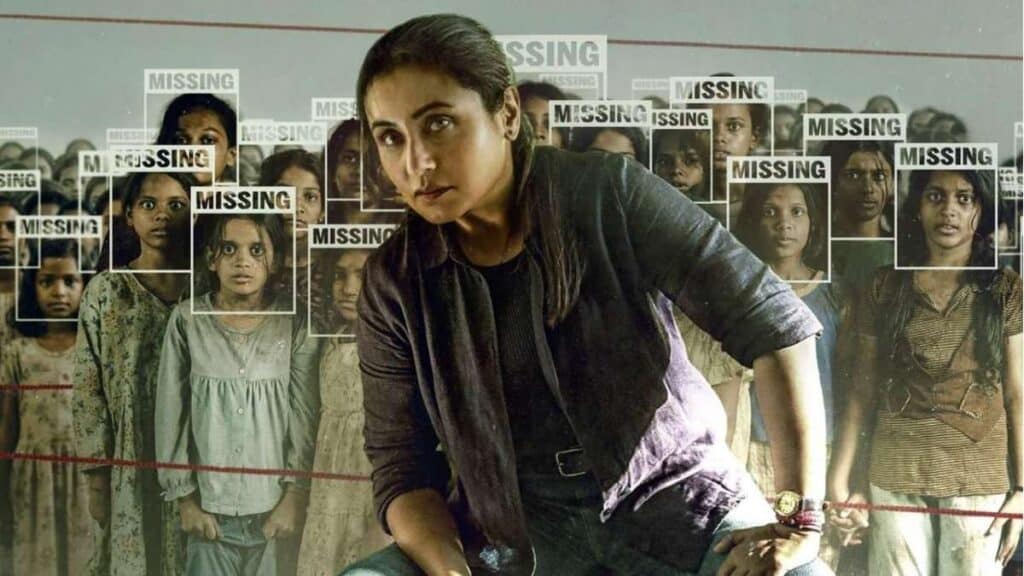
Rani Mukerji returns as the fearless IPS officer Shivani Shivaji Roy in Mardaani 3, the highly anticipated third installment of the franchise that has become synonymous with hard-hitting crime drama tackling social issues. This time, Shivani faces her darkest, most brutal case yet—dismantling a beggar mafia and child trafficking network—in what’s being described as the grittiest chapter of the series that will push both the character and audiences into uncomfortable, necessary territory.
Quick Summary:
Mardaani 3 releases theatrically on January 31, 2026, and will stream on Netflix from March 27, 2026. Directed by Abhiraj Minawala, the film stars Rani Mukerji as IPS officer Shivani Shivaji Roy investigating a beggar mafia and child trafficking ring, facing female antagonist Amma (Mallika Prasad).
Table of Contents
Mardaani 3 Release Date: When to Watch in Theaters and on OTT
Mark your calendars for January 31, 2026, when Mardaani 3 arrives in theaters nationwide, continuing the franchise’s tradition of tackling socially relevant crime stories through compelling action-thriller narratives. The theatrical release positions the film during a relatively open window in the release calendar, avoiding major festival clashes while capitalizing on audience appetite for content-driven cinema that offers both entertainment value and social commentary.
The timing also reflects strategic planning around content consumption patterns. The late January theatrical release captures audiences during a period when many have returned to normal routines after holiday season but are still seeking entertainment options. The late March OTT release positions the film for spring viewing when streaming consumption traditionally increases as people spend more time indoors during transitional weather.
The Plot: Shivani Shivaji Roy’s Darkest Case Yet
Mardaani 3 takes the franchise into its most disturbing territory yet, confronting the horrifying reality of beggar mafias and child trafficking networks that operate in plain sight across India, exploiting society’s most vulnerable while hiding behind facades of helplessness that make their crimes particularly insidious and difficult to combat.
The beggar mafia investigation forms the central narrative thrust. Shivani Shivaji Roy, now working with the National Investigation Agency (NIA)—a promotion from her previous Mumbai Crime Branch position that reflects both her proven capabilities and the national scope of the criminal network she’s targeting—leads an investigation into an organized crime syndicate that kidnaps young girls and forces them into begging operations that serve as cover for broader trafficking activities.
The human trafficking dimension expands the scope beyond forced begging to explore the interconnected networks that exploit children for various purposes—sexual exploitation, organ trafficking, forced labor, and other horrors that exist in shadows most people prefer not to acknowledge. Mardaani 3 appears committed to forcing that acknowledgment, making audiences confront uncomfortable realities about crimes happening in their communities, often in plain sight.
Amma as antagonist introduces fascinating dynamics to the confrontation. Previous Mardaani villains were male, creating narratives around patriarchal violence, male criminality, and gendered power dynamics where Shivani’s victories represented women’s resistance against male predation. Amma—a female antagonist leading this criminal network—complicates that framework. The battle becomes about more than gender; it’s about morality, humanity, and the choices people make regardless of their gender.
The “darkest and most intense” framing suggests Mardaani 3 won’t pull punches in depicting both the crimes being investigated and the toll such investigations take on those pursuing justice. The franchise has always balanced commercial action-thriller elements with social commentary, but this installment seems positioned to push further into uncomfortable territory, potentially testing audience tolerance while arguing that such discomfort is necessary to generate the outrage that drives social change.
The race against time element common to crime thrillers takes on particular urgency when victims are children whose suffering increases with every moment of continued captivity. The film likely employs this tension effectively—Shivani isn’t just solving a case, she’s trying to rescue specific children from immediate danger, creating ticking clock pressure that elevates stakes beyond abstract justice to concrete life-saving urgency.
Social justice themes woven throughout examine not just individual criminality but societal failures that enable it. Why do beggar mafias flourish? Partly because of poverty and desperation that provides vulnerable victims, partly because of corruption that allows criminal networks to operate without adequate law enforcement intervention, partly because of public indifference where people give to beggars without questioning the systems behind the begging, and partly because trafficking victims have limited agency to escape or seek help.
CHECK MORE ON:Kohrra Season 2 OTT Release Date: Barun Sobti & Mona Singh’s Netflix Crime Thriller
Meet the Cast: Rani Mukerji Returns with New Faces
Rani Mukerji reprises her defining role as IPS officer Shivani Shivaji Roy, a character that has become iconic in Indian cinema for presenting a female cop who’s tough, intelligent, emotionally complex, and utterly uncompromising when pursuing justice. Mukerji’s commitment to this character across three films demonstrates genuine investment in the franchise’s social mission beyond just commercial success.
Mallika Prasad as Amma introduces the franchise’s first female primary antagonist, a casting choice that fundamentally shifts the narrative dynamics. Prasad, an actress known for powerful performances in regional cinema, brings intensity and menace to a role that could have easily become stereotypical—the evil woman criminal—but instead appears nuanced and terrifying precisely because Amma isn’t portrayed as exceptional monster but as calculated businesswoman who happens to trade in human suffering.
Jankee Bodiwala joins the cast in what’s described as a pivotal role, reportedly playing a cop working alongside Shivani. Bodiwala, who gained attention for her performance in the horror-thriller Shaitaan, brings experience with intense, emotionally demanding material that should serve her well in Mardaani 3’s gritty narrative. Her character’s exact function remains somewhat unclear from available information, but the “pivotal role” designation suggests significant screen time and importance to the investigation.
Mikhail Yawalkar as Inspector Balwinder Singh Sodhi apparently reprises a role from previous Mardaani films (the character appeared in Mardaani 2), providing continuity and established working relationship that doesn’t require explanation or setup time. Sodhi’s presence suggests Shivani hasn’t completely left behind her Mumbai connections even while operating at NIA level, maintaining relationships with colleagues who know her methods and can provide ground-level support.
Director Abhiraj Minawala takes the helm for Mardaani 3, bringing experience from major Yash Raj Films productions including Sultan and Tiger 3. His background in large-scale action filmmaking suggests confidence in handling Mardaani 3’s action sequences, while his work on films with strong social themes indicates ability to balance commercial requirements with meaningful messaging.
CBFC Rating and Runtime: What to Expect
The U/A 16+ rating is relatively rare in Indian cinema, reserved for content deemed appropriate for viewers 16 and older, with parental guidance advised for those under 16. This more restrictive classification than the standard U/A rating (which simply requires parental guidance for children under 12) signals that the CBFC recognizes Mardaani 3 contains material—whether violence, thematic content, or disturbing imagery—that younger teenagers shouldn’t access without adult context and mediation.
The runtime evolution tells an interesting story about the editing process and content decisions. The film was initially approved at 137 minutes (2 hours, 17 minutes) in mid-January 2026. Following that approval, the filmmakers voluntarily made cuts totaling approximately 6.5 minutes, bringing the final theatrical version to 130 minutes and 37 seconds (2 hours, 10 minutes, 37 seconds).
How Mardaani 3 Continues and Evolves the Franchise
The Mardaani franchise began in 2014 with a film that was relatively unusual for mainstream Hindi cinema—a female-led action thriller centered on human trafficking that didn’t romanticize its protagonist or soften its subject matter significantly for commercial palatability. Directed by Pradeep Sarkar and produced by Aditya Chopra under Yash Raj Films, the original Mardaani introduced Shivani Shivaji Roy investigating child trafficking rings, establishing the character’s fierce determination and willingness to operate in morally grey areas when pursuing justice.
Mardaani 2 arrived in 2019, five years later, directed by Gopi Puthran and focusing on juvenile crime and rape. The sequel shifted setting from Mumbai to Kota, Rajasthan, and confronted the disturbing reality of young perpetrators committing brutal crimes, examining what creates such violence in teenagers and how law enforcement should respond when criminals are themselves minors. The film performed even better commercially than its predecessor, grossing over ₹95 crore worldwide, validating the franchise’s viability and appetite for these stories.
Mardaani 3’s evolution takes the franchise in several new directions while maintaining core identity. The shift to NIA-level investigation expands scope from regional crime to national networks, acknowledging that trafficking and organized exploitation aren’t localized problems but systemic issues requiring coordinated response across jurisdictions. This elevation also reflects Shivani’s character growth—her successes have earned her bigger responsibilities and more complex cases.
The franchise’s social impact extends beyond box office performance to measurable awareness-raising and conversation-generation. The films partner with NGOs working on trafficking prevention, use their platforms to educate audiences about warning signs and reporting mechanisms, and create cultural moments where these issues receive sustained public attention.
The Social Relevance: Why Mardaani 3’s Subject Matter Matters
Beggar mafias in India represent organized criminal networks that kidnap children, sometimes maim them to make them appear more pitiable and thus more profitable for begging operations, and force them into street begging where they’re controlled through violence, drug dependency, or threats to family members. These operations exist in virtually every major Indian city, often operating in plain sight at traffic signals, outside temples, and in crowded public spaces.
Child trafficking in India extends far beyond forced begging to include sexual exploitation, forced labor, domestic servitude, organ trafficking, forced marriage, and other forms of exploitation affecting millions of children. India is simultaneously a source country (children trafficked from India to other nations), transit country (children trafficked through India to other destinations), and destination country (children from neighboring nations trafficked into India).
Law enforcement challenges in combating these networks include corruption (some officials may be paid to ignore trafficking operations or warn networks about raids), limited resources (police in India are dramatically under-resourced and overwhelmed with multiple responsibilities), jurisdictional complexity (trafficking networks operate across state lines and national borders, requiring coordination that’s difficult to maintain), and lack of specialized training in identifying and investigating trafficking.
Social factors enabling trafficking include poverty (families in desperate circumstances may be deceived or coerced into giving up children, or in rare cases may sell children to traffickers), migration (families moving for work become vulnerable to traffickers who promise jobs or education), lack of birth registration (children without official documentation are easier to traffic because their disappearance goes unreported), and gender discrimination (preference for male children means female children are sometimes more vulnerable to being given away or sold).
Mardaani 3’s intervention in this landscape isn’t just entertainment—it’s cultural activism through popular medium. Films reaching millions of viewers can generate awareness that years of NGO campaigns struggle to achieve. When audiences see Shivani investigating beggar mafias, they may begin questioning the child beggars they see daily. When the film depicts trafficking networks, viewers may become more alert to suspicious situations in their own communities.
Action and Intensity: What Makes This the Grittiest Mardaani Yet
Director Abhiraj Minawala and star Rani Mukerji have both described Mardaani 3 as the darkest, most intense, and grittiest installment of the franchise, suggesting significant escalation in both action sequences and thematic heaviness from the previous films.
The action choreography apparently pushes boundaries for what the franchise has shown previously. While both earlier Mardaani films featured action sequences—Shivani isn’t a deskbound investigator but actively engages in confrontations, chases, and physical combat—Mardaani 3 escalates the physical demands. Mukerji has discussed the extensive training required and the physically punishing nature of the action sequences, which apparently include more hand-to-hand combat and intense confrontations than previous films.
The investigation sequences delve into the operational mechanics of beggar mafias and trafficking networks in ways that may disturb audiences precisely because they reveal how organized, systematic, and horrifyingly efficient these criminal operations are. Rather than portraying criminals as chaotic or impulsive, the film apparently shows the business-like efficiency with which vulnerable children are commodified, controlled, and exploited.
The emotional intensity comes from the stakes involved. When victims are children and the crimes are ongoing, every moment of delay means continued suffering. The film apparently doesn’t shield viewers from understanding what’s at stake—the physical and psychological trauma that trafficking inflicts, the permanent damage that can result, and the urgency of intervention before harm becomes irreversible.
Mukerji has described the challenge of inhabiting Shivani’s emotional state during filming, carrying the weight of investigating crimes against children while maintaining the character’s fierce determination and refusing to be broken by the darkness she confronts. This emotional authenticity separates the Mardaani films from more superficial action thrillers—Shivani isn’t unaffected by what she sees, and that emotional reality grounds the franchise in human experience.
The gritty visual style reflects subject matter, eschewing the glossy aesthetic of typical mainstream Hindi action films for something rawer and more realistic. The cinematography apparently emphasizes harsh lighting, tight framing during confrontations, and visual approaches that create claustrophobia and tension rather than beauty. This aesthetic communicates that these crimes happen in shadows, in spaces society doesn’t look, in conditions that comfortable middle-class audiences usually avoid confronting.
The sound design likely plays crucial role in creating intensity without relying exclusively on graphic imagery. Sound can suggest violence, convey threat, and build tension in ways that work on audiences psychologically without requiring explicit visual depiction. The Mardaani films have historically used sound effectively—children’s cries, threatening voices, environmental sounds that create menace—and this installment apparently continues that approach.
Why You Should Watch Mardaani 3
Beyond the fact that it’s a well-crafted action thriller featuring one of Indian cinema’s finest actresses in a role she’s made iconic, several compelling reasons make Mardaani 3 worth your time whether you’re catching it in theaters or streaming on Netflix.
Rani Mukerji’s performance alone justifies watching. Three films into the franchise, she inhabits Shivani with complete authenticity, creating a character who feels lived-in rather than performed. The physicality she brings to action sequences, the emotional depth she provides in dramatic moments, and the fierce intelligence she conveys during investigative sequences combine to create one of Hindi cinema’s most compelling protagonist performances.
The social importance of the film’s subject matter makes engagement valuable beyond entertainment. Most people remain blissfully unaware of the scale and nature of beggar mafias and child trafficking despite these crimes occurring in communities nationwide. Mardaani 3 educates audiences about realities we’d prefer to ignore but desperately need to understand if we hope to combat them.
The action and thriller elements deliver entertainment value independent of social messaging. If you enjoy well-crafted suspense, intense action sequences, cat-and-mouse investigations, and the satisfaction of watching competent professionals do their jobs well under pressure, Mardaani 3 provides all that within a tight, focused narrative that doesn’t waste time or test patience with unnecessary subplots.
The female antagonist dynamic creates fresh energy for the franchise. The Shivani versus Amma confrontation promises to explore dimensions of conflict, strategy, and will that previous installments with male villains couldn’t access. Watching two powerful women with completely opposite moral orientations clash intellectually and physically offers something distinct from typical action confrontations.
Supporting the franchise’s continuation through viewership sends message to the industry that audiences value this kind of socially conscious commercial cinema. Every successful film that tackles important social issues while remaining entertaining makes it easier for future filmmakers to greenlight similar projects. Your viewership contributes to creating space for more films that refuse to choose between entertainment value and social relevance.
The conversation catalyst that films like this provide creates value beyond the individual viewing experience. Watching Mardaani 3 with family, friends, or community members can spark discussions about trafficking, about the crimes depicted, about what individual and collective action might look like in response. These conversations ripple outward, creating awareness that extends beyond the film’s direct audience.