


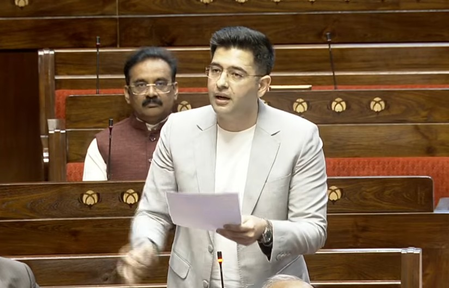
Aam Aadmi Party (AAP) Rajya Sabha member Raghav Chadha has urged for the implementation of a “Right to Recall” provision in India. This mechanism would enable voters to oust underperforming elected officials like MPs and MLAs before their term concludes. Chadha highlighted the lack of accountability and performance assessment in the current system during his address in the Rajya Sabha.
Chadha underscored a critical flaw in India’s electoral process, stating, “Before the election, the leader is after the public, and after the election, the public is after the leader.” He argued that the traditional five-year term is excessively long in today’s rapidly evolving world, emphasizing the detrimental impact of electing incompetent leaders on communities and regions.
Advocating for the Right to Recall, Chadha emphasized that it is not a tool against politicians but a safeguard for democracy. He referenced constitutional provisions and laws in India, such as the impeachment of the President and no-confidence motions, questioning why voters lack a similar recourse against ineffective MPs and MLAs.
Chadha cited examples from over 24 democracies worldwide, including Canada and Switzerland, where the Right to Recall is in place. He mentioned the recall of California Governor Gray Davis in 2003, illustrating how constituents can initiate removal processes in exceptional circumstances. In India, Chadha pointed out existing local-level practices in states like Karnataka, Madhya Pradesh, Maharashtra, and Rajasthan, where gram panchayat representatives can be recalled by gram sabha votes.
Proposing safeguards to prevent misuse, Chadha suggested prerequisites like an 18-month minimum performance period before a recall attempt, specific grounds for removal, and a substantial threshold of at least 50% voter approval in a recall vote. He believes that implementing such a system would compel political parties to nominate better candidates, eliminate underperforming assets, enhance India’s democratic maturity, and empower citizens by granting them continuous oversight over their representatives.
