


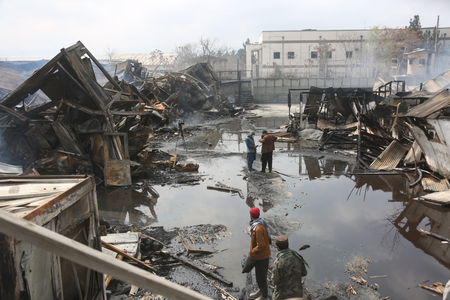
Several Afghan families were searching for their loved ones on Eid in Afghanistan following Pakistan’s airstrike on a drug rehab center in Kabul that resulted in the deaths of over 400 people on March 16. The Pakistani attack, aimed at “military and terrorist infrastructure,” tragically hit a rehabilitation center for drug addicts, causing a massive loss of lives.
On Eid, Sohrab Faqiri was desperately seeking his brother’s grave, who was killed in the airstrike on Kabul. Faqiri’s brother, Qais, a tailor and a father, had been undergoing treatment at the facility for three months. Despite Faqiri’s efforts to locate his brother among the survivors, he eventually found him in a video of the mass burial of the victims.
Faqiri visited hospitals in Kabul for two days in search of information about his brother but to no avail. He later identified his brother’s grave in a hillside graveyard where the burial had taken place. Faqiri expressed his distress at the lack of identification for the victims, stating, “Worst of all is that his grave is not known to us,” while at the cemetery.
The attack on the rehabilitation center occurred as patients were returning to their dormitories after night prayers during Ramadan. Wali Nazir Mohammad, a patient, recounted waking up to chaos and fire in his room after the explosion. Mohammad, injured by shrapnel, called for government action, urging for revenge or weapons to defend themselves.
Afghanistan’s Ministry of Interior spokesperson Abdul Matin Qane condemned Pakistan’s airstrike, warning of a strong response to the incident. Qane emphasized that such attacks would not be tolerated, labeling them as a violation of Afghanistan’s sovereignty. The tensions between Afghanistan and Pakistan have escalated recently due to airstrikes, artillery fire, and mutual accusations.
