


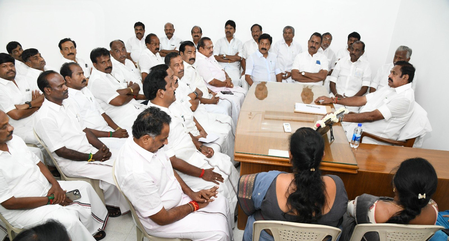
A power struggle has erupted within the AIADMK in Tamil Nadu as rival camps led by Edappadi K. Palaniswami and S.P. Velumani vie for control of the party’s legislature wing before a crucial trust vote. The battle has put Assembly Speaker J.C.D. Prabhakar in a pivotal position, as his decision on recognizing the party’s leader and chief whip could sway the voting pattern of MLAs and impact the government’s fate. Both factions have presented letters to the Speaker asserting majority support among AIADMK legislators.
The situation took a dramatic turn as signatures of several MLAs reportedly appear in letters from both rival camps, causing uncertainty over which faction truly holds majority support. Legal experts highlighted that the Speaker’s recognition of either faction would carry significant implications under the anti-defection law. If Palaniswami’s camp is acknowledged, AIADMK MLAs would be obligated to follow their whip and vote against the ruling alliance during the confidence motion.
Conversely, if Velumani’s faction receives recognition, a majority of AIADMK legislators may support the government without immediate disqualification risks. Observers noted that the Speaker has no fixed deadline to resolve the issue and could delay the decision due to the internal discord. However, he retains the power to promptly acknowledge a faction based on legislative strength and supporting evidence.
Experts clarified that while the AIADMK legislature party may operate as two distinct blocs in the Assembly, the Speaker lacks the authority to formally split the party. They emphasized that only the Election Commission can arbitrate disputes over party ownership or symbols, while the Speaker’s role is limited to recognizing the legislature party leader and whip for Assembly proceedings. As the trust vote looms, the Speaker’s ruling is poised to be a pivotal moment shaping the AIADMK’s future and the state government’s stability.
