


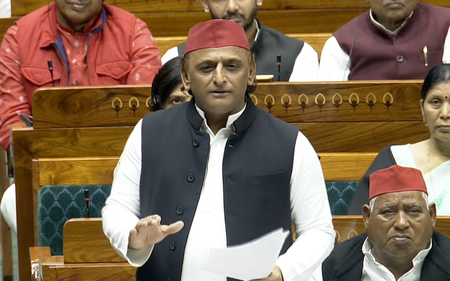
Samajwadi Party leader Akhilesh Yadav criticized the Indian government for its handling of the recent interim trade agreement with the US. He raised concerns about the sequence of events, questioning whether the Union Budget was finalized before the trade deal. Yadav highlighted the lack of official clarification from the BJP-led government regarding the trade agreement’s details.
During a Lok Sabha discussion on the Union Budget, Yadav expressed worries about India’s trade policies and the impact of free trade agreements. He specifically questioned the BJP’s stance on Free Trade Agreements with various nations and criticized the nature of the deal with the US, emphasizing delays and compromises made.
Yadav also raised doubts about the government’s focus on self-reliance and indigenous production in light of the trade pact. He questioned the removal of terms like “Aatmanirbharta” and “Swadeshi” from economic decisions, pointing out concerns about the trade’s impact on India’s self-reliance and domestic production goals.
The Samajwadi Party chief further criticized the Union Budget, claiming it neglected the marginalized communities. He accused the government of ignoring the needs of the poor, Dalits, and Adivasis, emphasizing the lack of provisions in the budget for these sections of society. Yadav also accused the BJP of interfering with reservation policies, stating that social and economic disparities were not addressed adequately in the budget.
Yadav highlighted the lack of attention given to Uttar Pradesh in the Budget’s infrastructure planning, pointing out the absence of significant new projects. He criticized the government for mainly focusing on completing projects initiated by previous administrations and failing to reflect a vision of developed India in upcoming projects.
Expressing concerns over the trade agreement’s impact on agriculture, Yadav emphasized the challenges faced by farmers and questioned the future of Indian agriculture if crops are imported from the US. He also drew attention to environmental issues, mentioning the deteriorating condition of major rivers like the Ganga and Yamuna, as well as worsening air quality in cities like Delhi and Mumbai.
