


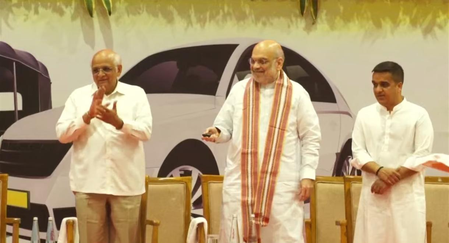
Union Home and Cooperation Minister Amit Shah introduced ‘Bharat Taxi’ in Gujarat, aiming to extend the service to 125 cities and 30 major urban centers in India by March 2027. The launch event, held in Gandhinagar, saw the presence of Chief Minister Bhupendra Patel, Deputy Chief Minister Harsh Sanghavi, state ministers, cooperative leaders, and numerous drivers known as “Sarathis.”
Bharat Taxi’s Chairman and GCMMF Managing Director, Dr. Jayen Mehta, highlighted the significance of the launch for the cooperative sector, emphasizing the principle of drivers also being owners. He mentioned the rapid growth of the platform since its inception in February this year, with around seven lakh Sarathis and 38 to 40 lakh customers joining within five months.
Dr. Mehta outlined the future plans of Bharat Taxi, indicating expansion to the capitals of 30 major states, principal urban centers, and over 125 cities within a year. The platform’s focus is on ensuring that every customer’s expenditure directly benefits the Sarathi drivers. Agreements were signed during the event with various public sector and institutional partners to enhance operations in Gujarat, integrating taxi services with metro stations, railway facilities, airports, and urban transport infrastructure.
Bharat Taxi operates on a cooperative ownership model, making drivers stakeholders rather than commission-paying partners. The platform offers services like WhatsApp-based airport bookings, Sarathi Assistance Centers, membership certificates, welfare kits, and collaborations with the State Bank of India for vehicle loans at concessional interest rates. Additionally, agreements with electric vehicle manufacturers aim to promote cleaner transport.
The statewide rollout of Bharat Taxi will initially cover cities like Ahmedabad, Gandhinagar, Surat, Vadodara, Rajkot, Anand, Bhavnagar, Amreli, Mehsana, Jamnagar, and Valsad in Gujarat, with plans for further expansion. Dr. Mehta emphasized Bharat Taxi’s commitment to trust for passengers, respect for Sarathis, and creating new societal opportunities, portraying it as a movement driving the cooperative sector forward.
