


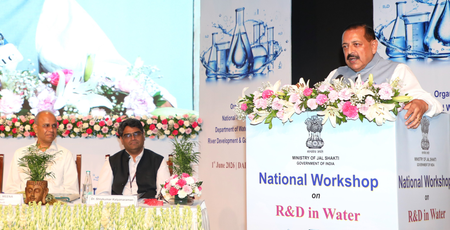
The Anusandhan National Research Foundation and the Ministry of Jal Shakti have initiated the MAHA Water Mission, a Rs 200 crore program aimed at supporting startups in the water sector. Dr. Jitendra Singh, Union MoS for Science & Technology, Earth Sciences, unveiled the mission, which will offer up to Rs 20 crore to selected multidisciplinary consortia. These funds will be utilized for technology development, field assessment, validation, and deployment of impactful water solutions.
The consortia eligible for this initiative can comprise universities, national laboratories, research organizations, startups, MSMEs, and industry partners. The MAHA Water Mission serves as a national platform designed to expedite innovation in the water sector by fostering connections among science, entrepreneurship, industry, academia, and grassroots efforts. It has a specific focus on five key themes, including water resource assessment, sustainable management, drinking water, water quality, ecological health, water use efficiency, circular economy, and climate resilience.
The mission’s objective is to promote innovations ranging from laboratory research to field implementation while creating scalable and localized solutions to enhance India’s long-term water security. Additionally, the event witnessed the signing of an MoU between the Department of Water Resources and the Department of Space/ISRO. Furthermore, the launch of the Jal Sanchay Jan Bhagidari, Citizen Tracking and Reporting (JSJB-CTR) Portal and App took place during the event.
Dr. Singh emphasized that the Anusandhan National Research Foundation (ANRF) is democratizing research funding by broadening opportunities for startups, MSMEs, universities, and innovators. By ensuring that national missions, scientific resources, and innovation support are accessible to a wider range of institutions, ANRF aims to widen access to resources, partnerships, and mission-oriented research opportunities across the country. The foundation has already initiated missions in strategic sectors such as electric vehicles, drones, medical technologies, 6G communications, and water, creating a comprehensive pathway from fundamental research to technology development, validation, and deployment.
