


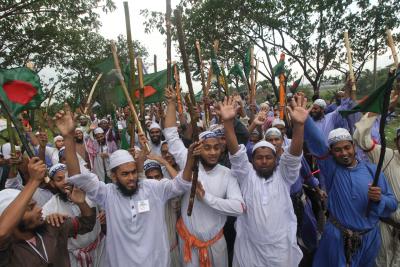
As campaigning for Bangladesh’s February 12 election begins, some political parties are claiming that voting against them is equivalent to voting against Islam, a tactic often used to discredit opponents as “anti-religion” when their political legitimacy is challenged. Reports indicate a rise in the banning of music education on religious grounds, attacks on shrines, threats to theatre, and arbitrary changes to textbooks across Bangladesh. Hasan Ferdous, an author and columnist for Prothom Alo, highlighted the historical use of religion to justify repressive actions, including the 1971 genocide against Bangladeshi Bengalis by Pakistani forces.
Religion is increasingly being exploited for political purposes in present-day Bangladesh, with several parties incorporating religious terms into their names. This manipulation of religion by politicians poses a threat to minority communities, as seen in the persecution faced by groups like the Ahmadis in Pakistan and the targeting of minorities in Bangladesh over social media posts. The politicization of religion has led to proposals such as reducing women’s work hours to five hours a day, aiming to limit women’s economic participation and confine them to domestic roles.
Amidst these challenges, Bangladesh finds itself at a critical juncture where the politicization of religion must be resisted through unified and vocal protests. Politicians across the ideological spectrum have exploited religion to justify their power grabs, necessitating a collective opposition to such groups to prevent the misuse of religion in politics. Recent reports have revealed the contradictory stance of Bangladesh’s radical Islamist party Jamaat-e-Islami, which publicly advocates for Shariah law despite signaling otherwise. At the grassroots level, supporters are urged to vote for Jamaat using religious rhetoric, underscoring the ongoing promotion of Shariah despite official disavowals.
