


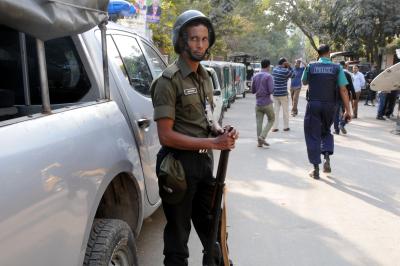
Bangladesh is grappling with a longstanding issue of Islamist extremism, which seems ingrained rather than sporadic, inherited from the previous interim government led by Muhammad Yunus. The current ruling government is confronted with a significant security threat that extends beyond the nation, posing broader regional security concerns. A recent report emphasizes that tackling terrorism has become a crucial test for the new administration.
The country has been placed on high security alert nationwide due to intelligence warnings of potential militant attacks on vital sites like the Parliament, security facilities, places of worship, recreational areas, and public spaces. This alert was issued following the apprehension of a member of a banned extremist group who claimed connections with two discharged military individuals, as reported by the ‘Dhaka Tribune.’ The intelligence evaluation, marked as “urgent confidential,” without disclosing the extremist group’s name, has raised fears of a resurgence of extremism in Bangladesh.
After the July 2024 Uprising, Bangladesh faced a prolonged period of severe security instability. The interim government that followed the fall of the Awami League government under Sheikh Hasina witnessed a breakdown in security, marked by mob violence, looting incidents, and mass jailbreaks. More than 70 militants reportedly escaped from prisons, accompanied by the theft of weapons from prison guards. During this period, 11 major criminals and 174 individuals associated with militant groups were released on bail. Of particular concern was the bail granted to ABT chief Jashimuddin Rahmani, accused of the murder of blogger Rajib Haider in 2013.
The report sheds light on the emergence of a transnational militant group, Hizb ut-Tahrir Bangladesh (HuT-B), banned in 2009 due to national security risks, which resurfaced during the interim government’s tenure, urging the withdrawal of the ban imposed by the previous administration. A demonstration in Dhaka led by educated college students brandishing an ISIS flag and advocating for an Islamic caliphate in Bangladesh brought attention back to the banned HuT-B. Subsequently, law enforcement arrested 10 individuals linked to this demonstration, including the organization’s media coordinator.
During the Yunus regime, Islamic extremism found a foothold in Bangladesh. Despite this, the interim government appointed Nasimul Gani, an alleged founding member of Hizb ut-Tahrir, as Home Secretary in December 2024. In March 2025, HuT-B organized a ‘March to Khilafat’ protest near Dhaka’s Baitul Mukarram mosque, which, though disrupted by authorities, underscored the unapologetic resurgence of Islamist extremism in the country during the interim rule.
