


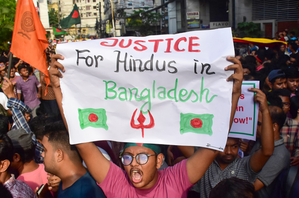
The recent increase in killings of Hindus in Bangladesh follows a troubling trend where violence against Hindu minorities escalates during periods of weakened state control. Hindu traders and small business owners are often targeted due to their economic prominence and social vulnerability. Their businesses, situated in public areas, make them easy targets, and the community lacks sufficient political influence to demand swift investigations.
The fatal attack on Mani Chakraborty, a Hindu grocery trader in Narsingdi, marks the sixth such incident in less than three weeks, highlighting the vulnerability of Bangladesh’s Hindu population. The assailants managed to escape unidentified despite the attack occurring in a busy market. This pattern of violence reflects a community marginalized from political attention, facing challenges amid a national transition that has disrupted protective institutions.
Bangladesh is currently navigating a unique political landscape following the departure of Sheikh Hasina, which has led to a decentralization of authority. The interim administration under Muhammad Yunus inherited a governance structure heavily reliant on a central authority, causing operational challenges in the absence of a clear chain of command. This shift has left law enforcement agencies in various districts uncertain about political directives and institutional support.
The escalating atrocities against minorities in Bangladesh not only signify violent crimes but also point to a breakdown in the state’s ability to safeguard its citizens. The recent spate of killings, including six Hindu men in less than three weeks, suggests that perpetrators perceive a distracted state with minimal repercussions. This combination of institutional fragility and communal tensions underscores the struggle of the state to protect its most vulnerable citizens.
