


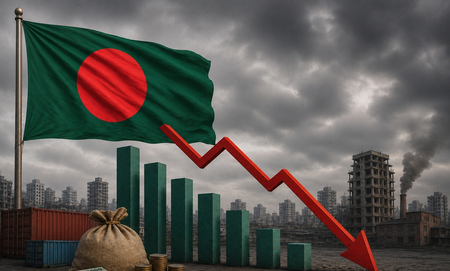
Bangladesh’s revenue collection lags globally, with the country gathering only about 8% of its GDP in government revenue in 2024, as per an IMF report cited by The Daily Star. This places Bangladesh just slightly above conflict-affected nations like Yemen and Sudan. Among Asian economies, Bangladesh has the lowest revenue-to-GDP ratio, significantly trailing countries like Pakistan and Sri Lanka, which record ratios of 12% and 13.68%, respectively.
Bhutan, in contrast, boasts a ratio of 26.97%, underscoring the disparity in revenue mobilization across the region. The global standard for tax-to-GDP ratio hovers around 15%, seen as a crucial threshold for ensuring sufficient public spending capacity and economic stability.
The report attributes Bangladesh’s weak revenue performance to various factors, including a limited tax base, prevalence of the informal sector, numerous tax exemptions, weak enforcement, and heavy reliance on indirect taxation. Additionally, a lack of public trust in institutions due to perceived corruption has hampered tax compliance, with citizens hesitant to pay taxes in the absence of tangible improvements in public services.
Due to the country’s meager revenue-to-GDP ratio, the government faces constrained fiscal space, impacting investments in crucial sectors like health and education. Bangladesh’s subpar performance in human capital development is linked to historical underinvestment in key social areas. Addressing these issues, the report emphasizes the urgent need to broaden the tax base, particularly targeting segments of the economy outside the formal tax system, such as rural markets and peri-urban business centers.
The report also stresses the importance of enhancing direct taxation, refining land valuation reporting, and expanding digital tax systems to curb evasion and enhance operational efficiency. While countries like Austria, Denmark, Finland, and Norway collect over 50% of their GDP in revenue, more than 70 developing economies fall below the 15% benchmark, indicating widespread fiscal challenges in the developing world.
