


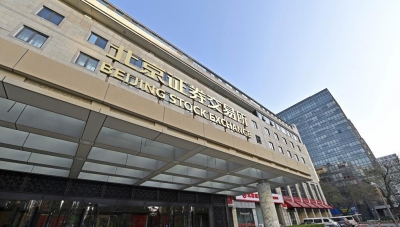
The Beijing Stock Exchange (BSE) operates as a strategic tool for China’s industrial policy rather than a liquidity-driven market, a recent report highlights. This stock exchange focuses on funding ‘little giant’ firms in key sectors, emphasizing strategic allocation and regulatory coordination over trading depth. With a market capitalization exceeding 900 billion yuan, the BSE, China’s third stock exchange, aims to support strategic industries without competing in scale with Shanghai or Shenzhen exchanges.
China’s domestic markets like the BSE are assuming a more significant role in financing innovation amid rising risks in overseas listings for Chinese companies. Over 80% of BSE-listed firms operate in strategic emerging industries, with about 53% participating in China’s Little Giants initiative, supporting small-scale firms in crucial technological sectors. Despite rapid growth in listings, the BSE faces challenges such as narrow investor structure and limited liquidity, with retail investors dominating and institutional investors contributing less than 10% to trading.
The BSE’s unique characteristics, including small firm size, limited analyst coverage, and exclusion from benchmark indices, deter institutional investor interest. This results in low liquidity, intentionally prioritized by the exchange to focus on strategic financing and regulatory control rather than market-driven price discovery. Unlike other exchanges with higher turnover and valuation premiums, the BSE serves as a stable platform for firms with slower growth prospects, reflecting Beijing’s preference for strategic capital allocation over market dynamics.
