


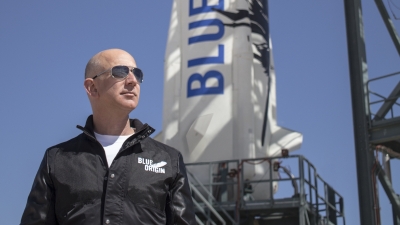
Jeff Bezos’ Blue Origin has decided to halt its space tourism operations temporarily and shift its focus towards landing humans on the Moon. The company announced in a blog post that it will be putting its New Shepard, the first reusable spaceflight system with vertical landing capabilities, on hold for at least two years. This move is aimed at accelerating the development of Blue Origin’s capabilities for lunar missions.
Since 2021, the New Shepard has been offering suborbital space flights, allowing passengers to experience around 11 minutes above the Karman line, which marks the boundary of space. Blue Origin has conducted 38 flights to date, carrying a total of 98 individuals above this boundary, with the most recent flight occurring just a week ago. Additionally, the company has launched over 200 scientific and research payloads for various entities, including students, academia, research organizations, and NASA.
Blue Origin’s decision to pause space tourism aligns with its dedication to supporting the nation’s objective of returning to the Moon and establishing a sustainable presence there. The company holds a significant contract worth $3.4 billion with NASA for the development of the Blue Moon lander, which is intended to transport NASA astronauts to and from the lunar surface. The Blue Moon is set to play a crucial role in the Artemis 5 mission, scheduled for a 2029 launch, and a prototype version, the Blue Moon Mark 1 (MK1-SN001), is planned for a robotic mission to the Moon later this year.
Meanwhile, Blue Origin has also unveiled plans to create a satellite communication network named TeraWave, which aims to provide connectivity to data centers, governments, and businesses. The deployment of this network is expected to commence in the fourth quarter of 2027, showcasing the company’s commitment to expanding its technological capabilities beyond space tourism.
