


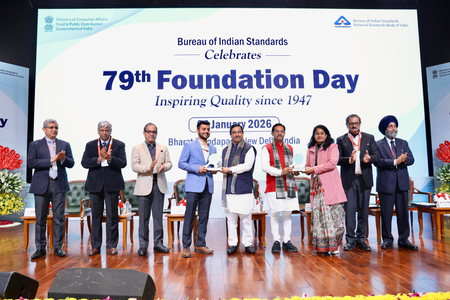
2025 marked a significant year for the Bureau of Indian Standards (BIS, as it introduced more than 600 new standards, bringing the total to 23,293 across various fields like AYUSH, robotics, artificial intelligence, and ecology. Sanjay Garg, the Director General of BIS, revealed that the number of products certified under the fast-track scheme surged from 758 to 1,288.
During the same year, around 9,700 new licenses were issued, with the majority processed within 30 days, pushing the total count of product certification licenses to over 51,500. Notably, 124 new products were mandated to obtain BIS certification in 2025, expanding the total certified products to over 1,437, including currency note sorting machines in collaboration with RBI and injection molding machines aligned with ISO standards for machinery safety.
At the 79th BIS Foundation Day event, Garg emphasized the organization’s digital initiatives like the Manak Online Portal, streamlined licensing procedures, fast-track trial licenses, cluster-based testing facilities, and enhanced testing infrastructure. As a result, 98% of licenses under the simplified process and 85% under the normal process are granted within 30 days.
Union Minister Prahlad Joshi commended BIS for its continuous evolution in standardization by embracing globally recognized best practices. He highlighted that Indian Standards now encompass a wide range of sectors beyond the traditional, including renewable energy, electric mobility, smart infrastructure, digital technologies, sustainability, green products, and emerging areas like bomb disposal systems and electric agricultural tractors. Joshi stressed the transformation of BIS under Prime Minister Narendra Modi’s leadership, shifting from regulation to facilitation and from compliance to a quality-oriented culture.
In alignment with the government’s emphasis on improving the business environment, BIS has streamlined compliance procedures, offered fee relaxations for MSMEs and laboratories, made in-house laboratory requirements optional for large industries, and bolstered market surveillance to ensure the quality of consumer goods. To aid MSMEs, BIS grants concessions in the Annual Minimum Marking Fee — 80% for Micro, 50% for Small, and 20% for Medium Enterprises.
