


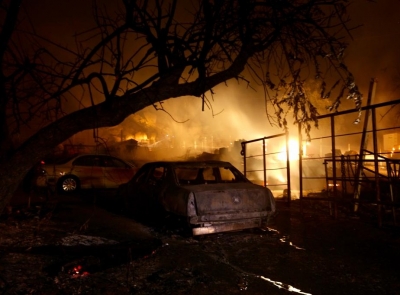
Even before California’s peak fire season, firefighters in the state have already responded to more than 2,580 wildfires this year. The rising temperatures and dry vegetation have heightened concerns, leading officials to warn of a year-round fire threat.
Several wildfires, including those in Riverside, Kern, and San Diego, remained active on Monday. Fire officials anticipate above-average fire activity in the coming months due to hotter and drier conditions. This changing pattern has led California fire authorities to shift away from the term “fire season.”
David Acuna, a battalion chief of the California Department of Forestry and Fire Protection (CAL FIRE), emphasized the need to refer to a peak “fire year” instead of a traditional fire season. According to CAL FIRE, the state has witnessed 2,584 wildfires burning over 79,690 acres this year, with no confirmed fatalities but 25 structures destroyed.
The combination of prolonged drought, rising temperatures, and dry vegetation has made California more susceptible to fast-spreading fires. The heavy growth of vegetation from previous wet periods has now become fuel as plants dry out under the hotter conditions. Brent Pascua, another CAL FIRE battalion chief, highlighted the predictive models indicating an above-average peak fire season.
Climate change is identified as a key factor altering the timing and intensity of California wildfires. A study led by researchers at the University of California, Los Angeles, revealed that human-induced climate change has advanced the start of the state’s fire season by six to 46 days between 1992 and 2020. The study emphasized fuel aridity as a significant factor influencing the onset of the fire season.
California Governor Gavin Newsom, in a recent proclamation during Wildfire Preparedness Week, stressed that climate change is fueling extreme weather conditions that can escalate a small spark into a catastrophe. Newsom’s office highlighted the state’s increased budget for CAL FIRE since 2019, the expansion of firefighting personnel, and the establishment of what is described as the “world’s largest aerial firefighting fleet.”
Fire officials are urging residents to prepare in advance for worsening conditions. Recommendations include creating defensible spaces around homes, fortifying structures with fire-resistant materials, assembling emergency kits, and registering for local emergency alerts. CAL FIRE Director Joe Tyler emphasized the need for readiness due to drier-than-average conditions across the state.
As California experiences wildfires year-round, officials stress the importance of preparedness for both emergency crews and residents well before the traditional peak fire months.
