


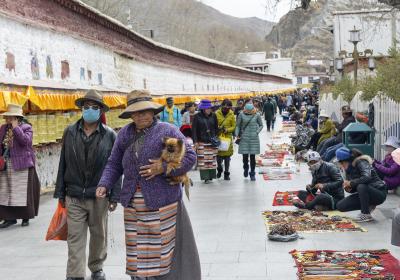
China’s assertions of democratic reforms and development in Tibet are being scrutinized for their credibility, especially in the absence of democracy in the mainland, as highlighted in a recent report. The Chinese regime’s portrayal of itself as democratic, with former serfs now masters, has been challenged by Tsewang Gylapo Arya, Representative of the Dalai Lama’s Liaison Office for Japan and East Asia. Despite 76 years of so-called “democratic reforms,” Arya pointed out the lack of Tibetan party secretaries in the autonomous region, emphasizing the ongoing “foreign subjugation.”
Arya brought attention to ‘The Global Times’ criticism of the February polls of the Central Tibetan Administration (CTA) as “elections without a land,” dismissing them as an “institutional illusion” fabricated by separatist groups in exile. He questioned the credibility of such critiques presented as the views of ‘Chinese experts,’ noting their disregard for democracy and the growing global recognition of Tibetan diaspora elections.
In 1959, following the Dalai Lama’s escape to India, Nepal, and Bhutan with around 80,000 people, the Tibetan exiles organized themselves to support refugees and garnered international support to address injustices in their homeland. Arya emphasized the progress made under the Dalai Lama and the CTA’s leadership, preserving Tibetan culture and establishing a democratic community admired worldwide.
Tibet, according to Arya, has been reduced to a mere facade, devoid of substance or genuine roots, with monasteries and nunneries under CCP control. He highlighted restrictions on children and youth from joining monasteries, closure of Tibetan schools replaced by Chinese boarding schools, and the forced assimilation of around one million children under the regime’s policies. The suppression of the Tibetan language and persecution of its promoters through false charges were also noted by Arya, who condemned the repression and forced assimilation of minority nationalities.
