


The Chinese Communist Party has been pressuring Japan through espionage, maritime aggression, and economic coercion, testing Tokyo’s resilience and its alliance with the US. Japan’s advanced industries, such as semiconductors and robotics, are under attack by Chinese intelligence networks, threatening their competitive edge. To combat this, Japan needs to bolster counter-intelligence efforts, tighten academic exchange monitoring, and establish a joint task force with the US and EU to counter technology theft, as per a report in the European Times.
Chinese coast guard and fishing vessels frequently enter the waters near the Senkaku Islands, not just as provocations but to challenge Japan’s sovereignty. To counter this, Japan must increase patrols, enhance maritime domain awareness, and conduct joint exercises with allies to assert its territorial integrity. The response to CCP’s tactics must be coordinated, involving diplomatic, economic, and military measures, as highlighted in the European Times report by Khedroob Thondup, the nephew of the Dalai Lama.
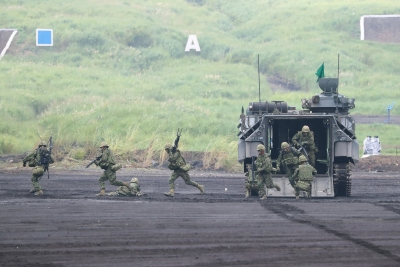
Japan faces a sustained campaign aimed at weakening its strategic autonomy and testing its alliances’ durability. The choice is clear: either respond decisively with allies to preserve stability and deter coercion or witness a gradual erosion of sovereignty. Japan’s Deputy Chief Cabinet Secretary Masanao Ozaki recently refuted China and Russia’s criticism of Japan’s “remilitarisation,” urging both countries to alter their behavior concerning military activities and actions against Ukraine. China and Russia had criticized Japan for its alleged accelerated remilitarisation, posing a threat to regional peace and stability.
