


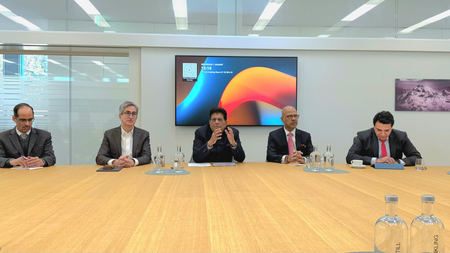
Commerce and Industry Minister Piyush Goyal recently engaged in a business roundtable with entrepreneurs from Liechtenstein companies, urging them to consider the opportunities arising from the $100 billion commitment to invest in India by European Free Trade Association (EFTA) nations. Goyal emphasized that the India-EFTA Trade and Economic Partnership Agreement (TEPA) goes beyond just trade, serving as a platform to boost investment, technology collaboration, skill development, and resilient value chains.
He highlighted various sectors, including precision engineering, clean energy, smart infrastructure, advanced materials, digital manufacturing, and financial services, where opportunities for collaboration exist. Goyal encouraged Liechtenstein businesses to view India as a strategic long-term base for their aspirations, referencing the substantial investment commitment made by EFTA nations, totaling $100 billion over 15 years and expected to generate one million direct jobs in India.
During his visit, Goyal also visited the Hilti Group headquarters in Liechtenstein and met with its CEO, Jahangir Doongaji. Discussions revolved around enhancing localization, increasing value addition, and expanding global shipments from India, aligning with the country’s manufacturing and export growth objectives. The minister emphasized the importance of technology collaboration to develop safer and smarter infrastructure, underpinned by increased investments, rapid innovation, and robust domestic capacity building.
Furthermore, Goyal held discussions with Liechtenstein’s Deputy Prime Minister and Foreign Minister, Sabine Monauni, focusing on enhancing trade, innovation, and clean-tech cooperation. The India-European Free Trade Association (EFTA) Trade and Economic Partnership Agreement (TEPA) became operational in October 2025, involving Switzerland, Norway, Iceland, and Liechtenstein. Goyal’s recent two-day trade talks in Brussels aimed to advance negotiations on the India-EU Free Trade Agreement (FTA), with a particular emphasis on securing zero-duty access for labor-intensive sectors like textiles, leather, apparel, gems and jewelry, and handicrafts.
