


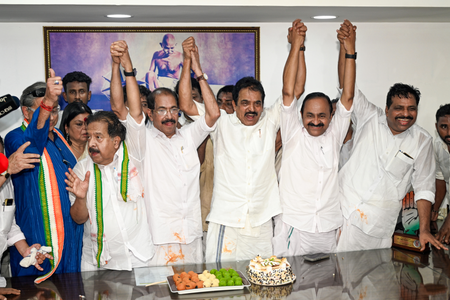
The United Democratic Front (UDF), led by the Congress, has made a strong comeback in Kerala after a decade, securing 102 seats. This victory signifies a significant political shift in the state, following the CPI-M’s Pinarayi Vijayan’s consecutive term in 2021.
The Congress played a pivotal role in this win, securing a record 63 seats and establishing a dominant position within the alliance. However, the victory also brings forth challenges, starting with the crucial decision of selecting the Chief Minister.
The leadership dynamics within the Congress in Kerala present a complex scenario, with influential figures like Leader of the Opposition V. D. Satheesan, former leader Ramesh Chennithala, and Congress General Secretary K.C. Venugopal vying for prominence.
The decision-making process for the Chief Minister’s post is expected to involve careful considerations due to the varied power centers within the party. While tradition favors the Leader of the Opposition for the role, factors like experience and central leadership proximity add layers of complexity to the decision.
Cabinet formation, another critical task ahead, will require a delicate balance among allies and factions, considering Kerala’s limit of 21 ministers. Key UDF constituents like the Indian Union Muslim League and the Kerala Congress-Joseph are likely to seek significant cabinet representation.
Accommodating smaller allies and individual leaders within the cabinet structure poses a challenge, as diverse interests and expectations need to be managed effectively. The presence of former CPI-M members contesting under the UDF banner further adds intricacies to the coalition’s governance strategy.
The UDF and the Congress leadership face the challenge of navigating through these complexities to ensure stable governance and unity within the alliance. While the election victory provides a platform for decisive governance, managing internal dynamics and expectations will be crucial for long-term success.
