


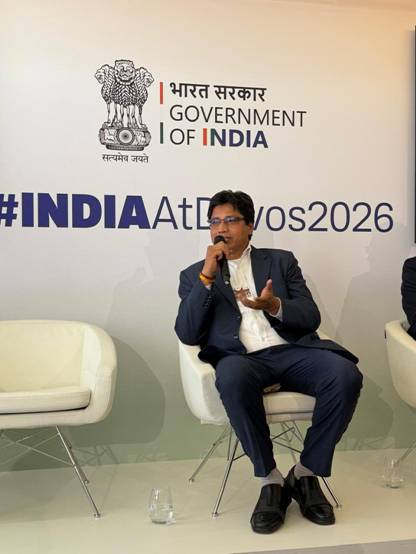
Decentralised renewable energy could lead to a significant decrease in government subsidies and cut down on Aggregate Technical and Commercial losses, according to Pradip Kumar Das, the Chairman and Managing Director of Indian Renewable Energy Development Agency Limited (IREDA). Speaking at a panel discussion during the World Economic Forum Annual Meeting 2026 in Davos, Das highlighted how this form of energy can enhance system efficiency and reduce reliance on subsidies, ultimately making electricity more affordable, especially in rural and agricultural regions.
The discussion focused on how India’s expertise in distributed solar power could offer practical solutions for emerging economies. Das emphasized that decentralised renewable energy not only enhances system efficiency but also reduces the need for subsidies and minimizes losses in power distribution. By doing so, overall costs are lowered, ensuring affordable electricity for consumers, particularly in rural and agricultural areas.
Union Minister for New and Renewable Energy, Pralhad Joshi, also addressed the audience, emphasizing India’s leadership in promoting solar energy for inclusive and sustainable development. He highlighted the country’s policy framework and institutional support that have facilitated the expansion of clean energy solutions across various sectors. Additionally, Das mentioned that with proper project design and robust risk management, emerging renewable energy segments can be effectively de-risked, pointing to IREDA’s successful track record in this regard.
IREDA’s pivotal role in expanding rooftop and agricultural solar power was underscored by Shri Das, who mentioned that the agency finances a significant portion of project costs under the Rooftop Solar and PM-KUSUM schemes through aggregator models. This approach has played a crucial role in accelerating clean energy access in rural India. Das expressed gratitude to Union Minister Pralhad Joshi for providing IREDA with the platform to showcase India’s renewable energy journey on a global scale, attributing India’s success in this sector to a well-established renewable energy ecosystem and institutional framework that can serve as a model for other nations transitioning to renewable energy.
