

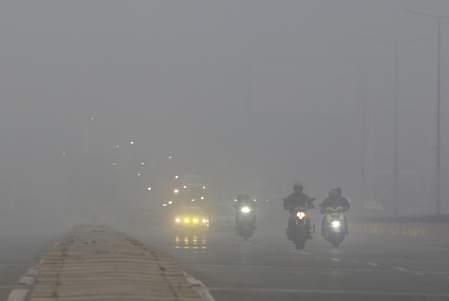
The national capital, Delhi, faced heavy smog on Monday morning, with air quality levels staying in the “very poor” category and some areas reaching “severe” pollution levels. This situation raised health worries for residents and disrupted daily life in the city. Data from the Sameer app showed Delhi’s average Air Quality Index (AQI) at 366 around 7.05 a.m. The Narela monitoring station reported the worst air quality with an AQI of 418, the highest in the city that day. Other areas like Anand Vihar, Bawana, Jahangirpuri, Mundka, Rohini, and Wazirpur also experienced severe air quality, with AQI readings ranging from 401 to 408. Even the least polluted area, Dilshad Garden, had an AQI of 301, falling under the “very poor” category. The Central Pollution Control Board (CPCB) classifies AQI levels between 301 and 400 as “very poor” and readings between 401 and 500 as “severe”. Such pollution can lead to respiratory issues, especially for children, the elderly, and those with existing health conditions. The dense smog reduced visibility in Delhi, leading the Indira Gandhi International (IGI) Airport to issue a passenger advisory. The airport implemented low-visibility procedures, but flight operations continued as usual. Passengers were advised to check with their airlines for updates as weather conditions could cause delays. The India Meteorological Department (IMD) predicted moderate fog for the day, with temperatures expected to reach around 21 degrees Celsius as a maximum and 9 degrees Celsius as a minimum. On the previous day, Delhi recorded a minimum temperature of 9.4 degrees Celsius, slightly above the seasonal average, while the maximum temperature was 18.1 degrees Celsius, contributing to the cold and polluted conditions in the city.
Delhi Continues to Suffer from Severe Smog, Air Quality Remains Very Poor


Indian Community Editorial Team
The Indian Community Editorial Team curates, verifies, and publishes stories that matter to Indians worldwide. From culture and community to business and innovation, our mission is to spotlight voices, ideas, and events that bring our global community closer together. Have news or a story to share? Submit it to us at [email protected].
Add A Comment