


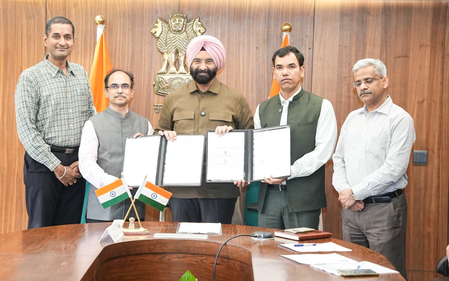
The Delhi government has teamed up with the Indian Institute of Technology Madras (IIT Madras) to conduct a pilot study on photocatalytic “smog-eating” surfaces. This project aims to address pollutants like Nitrogen Dioxide (NO₂) and Volatile Organic Compounds (VOCs) that contribute to urban smog. The study will explore the effectiveness of utilizing Titanium Dioxide (TiO₂) or similar safe photocatalysts to combat air pollution in Delhi.
The Memorandum of Understanding (MoU) signing event was graced by Manjinder Singh Sirsa and Prof. Somnath C. Roy from IIT Madras’s Department of Physics, who will lead the study. Officials from the Department of Environment and the Delhi Pollution Control Committee (DPCC) were also in attendance. The objective is to identify durable and cost-effective methods to apply ‘smog-eating’ coatings on various city surfaces, aiming to reduce Nitrogen Dioxide and other harmful pollutants.
The study will span six months and focus on assessing the integration of photocatalytic materials like TiO₂ into concrete, asphalt, and surface coatings on infrastructure. Additionally, innovative panels made from Titanium Dioxide-based materials will be explored for deployment on rooftops or streetlights to directly remove pollutants from the air. The initiative aligns with the government’s commitment to promoting innovation and sustainable solutions for environmental challenges.
Prof. Somnath C. Roy emphasized the study’s meticulous approach, starting with lab testing in a smog chamber at IIT Madras to measure pollutant abatement accurately. Subsequently, field assessments will be conducted in Delhi’s urban environment to evaluate the durability and efficiency of these surfaces under real-world conditions. The study underscores the importance of scientific interventions in combating air pollution and fostering sustainable urban development.
