


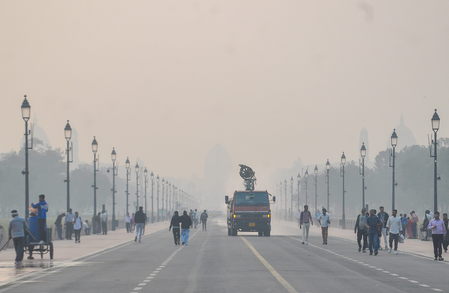
Delhi’s air quality declined to the ‘poor’ category on Saturday, with Rohini recording the highest Air Quality Index (AQI) of 372, as per data from the Central Pollution Control Board (CPCB). Residents woke up to a misty and unusually warm morning, with pollution levels remaining a concern in various parts of the national Capital. Several monitoring stations reported alarming AQI levels, including Anand Vihar at 332, Ashok Vihar at 237, and Chandni Chowk at 276, among others.
This drop in air quality follows a day of relatively better conditions. On Friday, Delhi’s overall AQI was at 186 at 9 a.m., categorizing the city as ‘moderate.’ However, out of the 39 monitoring stations, 24 recorded ‘moderate’ air quality while 14 stations reported ‘poor’ levels. February has seen persistent pollution, with 20 ‘poor’ air quality days and two ‘very poor’ days.
February 2026 marks Delhi’s worst air quality for the month in three years, with an average AQI of 234 until February 26. Comparatively, the average AQI was 237 in 2023, 218 in 2024, 214 in 2025, and 225 in 2022. This February has not only been highly polluted but also the warmest in the past three years, with temperatures exceeding the long-term average.
Experts attribute the warmer weather to the absence of active western disturbances, leading to clear skies and higher daytime temperatures. With minimal rainfall this month, pollutants have lingered in the atmosphere. The India Meteorological Department forecasts clear skies with a chance of mist at night, indicating an early shift to pre-summer conditions in the National Capital Region.
