


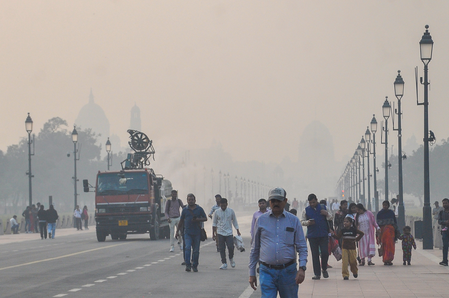
The Air Quality Index (AQI) in Delhi stayed in the ‘poor’ category on Thursday, with levels above 300 at various monitoring stations, indicating worsening air conditions in parts of the city. Specific areas like Anand Vihar, Jahangirpuri, and Chandni Chowk reported AQI levels in the ‘very poor’ range, with readings ranging from 306 to 337. Other locations such as Bawana, Burari Crossing, and Jawaharlal Nehru Stadium also recorded ‘poor’ air quality levels.
As per the AQI classification, readings between 0 and 50 are considered ‘good’, while 51 to 100 are ‘satisfactory’, 101 to 200 are ‘moderate’, 201 to 300 are ‘poor’, and 301 to 400 are ‘very poor’. Despite slight improvements, pollution levels continue to be a concern for residents, especially vulnerable groups in the city.
The India Meteorological Department (IMD) issued a yellow alert for Thursday, warning of moderate fog in many places across Delhi. The weather forecast suggests shallow to moderate fog during morning hours over the next six days, except on January 31 and February 1. The maximum temperature is expected to be around 18 degrees Celsius, with a minimum of 7 degrees Celsius, and the sky likely to remain generally cloudy throughout the week.
IMD’s latest forecast indicates the possibility of very light rain, thunderstorms, lightning, and gusty winds on the night of January 31. Light rain spells are also expected on February 1. Saturday and Sunday may experience light rain and gusty winds, leading to a temporary drop in temperature. Post February 1, temperatures are expected to rise gradually, with minimums around 13 degrees Celsius and maximums reaching 19 degrees Celsius.
In a related update, the Sub-Committee on the Graded Response Action Plan (GRAP) under the Commission for Air Quality Management (CAQM) lifted all Stage III actions across Delhi-NCR on January 22 due to improved air quality and favorable forecast trends. Despite this, health experts recommend residents to continue taking precautions, including wearing masks outdoors, to minimize direct exposure to polluted air.
