


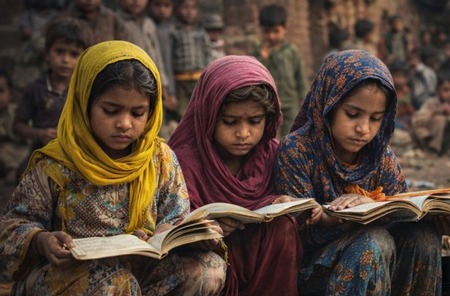
A leading rights group has labeled the education crisis in Pakistan a “national shame,” pointing out that millions of children being out of school signifies wasted potential and a failing system. Data from the United Nations International Children’s Emergency Fund (UNICEF) indicates that around 25.1 million children aged 5–16 are not receiving education in Pakistan, ranking the country as the second-worst globally in terms of children missing out on schooling.
The crisis is widespread across Pakistan’s provinces, with Punjab having the highest number of out-of-school children at 9.7 million, followed by Sindh with 7.4 million, representing 44% of its school-age population. Khyber Pakhtunkhwa records 34% of children out of school, while Balochistan is the most severely affected, with almost 69% of children aged 5–16 deprived of education.
Even in the capital city of Islamabad, approximately 90,000 children are not attending school, underscoring the nationwide failure in providing education. The Voice of Pakistan Minority (VOPM) highlighted the gender gap as an additional injustice, citing UNICEF reports that show more girls than boys are out of school in Sindh and Khyber Pakhtunkhwa, reflecting deep-rooted social and cultural barriers hindering girls’ right to education.
According to the VOPM, the education crisis in Pakistan is largely due to chronic underfunding of the education system. Historically, Pakistan has allocated only about 1.5% of its GDP to education, significantly below the UNESCO and Sustainable Development Goal 4 benchmark of 4–6%. The group also referenced the Pakistan Economic Survey 2024–25, which revealed a meager 0.8% of GDP allocated to education, with the majority of the budget consumed by teacher salaries, leaving minimal resources for infrastructure, learning materials, or systemic improvements.
The consequences of this underfunding are dire, with millions of children, especially girls and those in marginalized areas, being deprived of education, pushing them into early labor, exploitation, and perpetual poverty. The VOPM warned that without immediate investment and policy changes, Pakistan risks losing an entire generation of educated individuals. The group emphasized that the slow progress in enrollment and learning outcomes in Pakistan is not inevitable but rather a result of leadership failures, inadequate planning, and misplaced priorities.
