


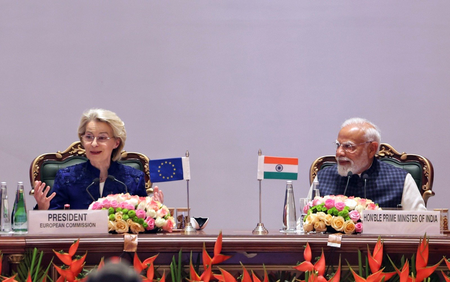
The European Union refuted claims that President Donald Trump’s trade policies influenced the signing of a significant free trade agreement with India. Christophe Kiener, the EU’s chief negotiator, emphasized that the pact resulted from long-standing political commitment and shared strategic goals, rather than recent geopolitical shifts. Kiener highlighted the mutual interests driving closer EU-India ties, emphasizing the strategic and economic benefits for both parties.
Kiener clarified that the trade agreement’s foundations were established before recent trade uncertainties, emphasizing the broader partnership between the EU and India. He described the agreement as pivotal in strengthening economic relations between the two major democracies, encompassing trade, security, defense, mobility, and technology. The negotiations, which recommenced in 2022, were based on fresh perspectives rather than previous draft texts, reflecting the evolving global trade landscape.
The need for enhanced cooperation was reinforced by various factors, including challenges in global trade liberalization, lessons from the Covid-19 pandemic, and geopolitical instabilities. Both sides aimed to bolster economic ties through predictable rules and resilient supply chains. India’s chief negotiator, Darpan Jain, dismissed claims that the agreement was a response to US trade policy shifts, emphasizing India’s broader strategy to expand market access through trade agreements.
Jain highlighted India’s commitment to deepening trade relations and addressing challenges faced by Indian exporters. The negotiators underscored that the agreement holds significance beyond commerce, sending a strong geopolitical message about transparent and rules-based trade. The pact is yet to undergo legal review and ratification, with EU officials aiming for signing this year and implementation next year, while Indian approval process is expected to be straightforward.
