


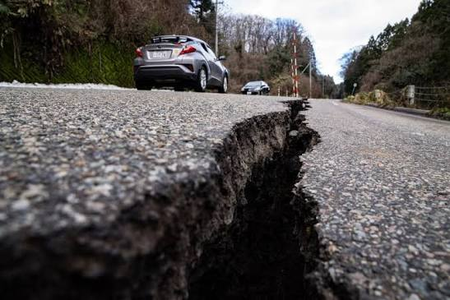
At least four individuals sustained injuries when a 7.2-magnitude earthquake hit northeastern Japan on Thursday morning. The quake, initially reported as a 6.9 magnitude, occurred around 7:30 a.m. local time off the eastern coast of Iwate Prefecture at a depth of approximately 40 km. The Japan Meteorological Agency (JMA) stated that the earthquake reached an upper 6 on Japan’s seismic scale in Hashikami Town and a lower 6 in Hachinohe City, both in Aomori Prefecture.
The JMA reported that an upper 6 intensity signifies that it is impossible to stand or move without crawling, and most unsecured furniture will shift, causing objects to fall over. The earthquake also impacted several other prefectures, including Hokkaido, Akita, Fukushima, Miyagi, Yamagata, Tokyo, and its neighboring areas. Despite this, no tsunami warning was issued, although individuals in severely affected regions were advised to stay vigilant for potential earthquakes of similar magnitude.
There were no indications of irregularities at the Higashidori or Onagawa nuclear power plants in Aomori and Miyagi prefectures, respectively, or at the Fukushima Daiichi or Daini nuclear power plants in Fukushima Prefecture, according to the plant operators. The earthquake’s epicenter was pinpointed at 40.2 degrees north latitude and 142.3 degrees east longitude.
In a separate incident, Venezuela experienced two powerful earthquakes in rapid succession, both causing significant tremors in Caracas, the capital city. The US Geological Survey (USGS) recorded a magnitude 7.1 quake at 2204 GMT on Wednesday, followed by an even stronger magnitude 7.5 tremor just a minute later near the coastal town of Moron, approximately 160 km west of Caracas. These earthquakes were shallow, with a depth of 10 km, potentially amplifying their destructive effects.
Following the seismic events, Venezuela’s Acting President Delcy Rodriguez declared a State of Emergency due to the extensive damage caused by the earthquakes.
