


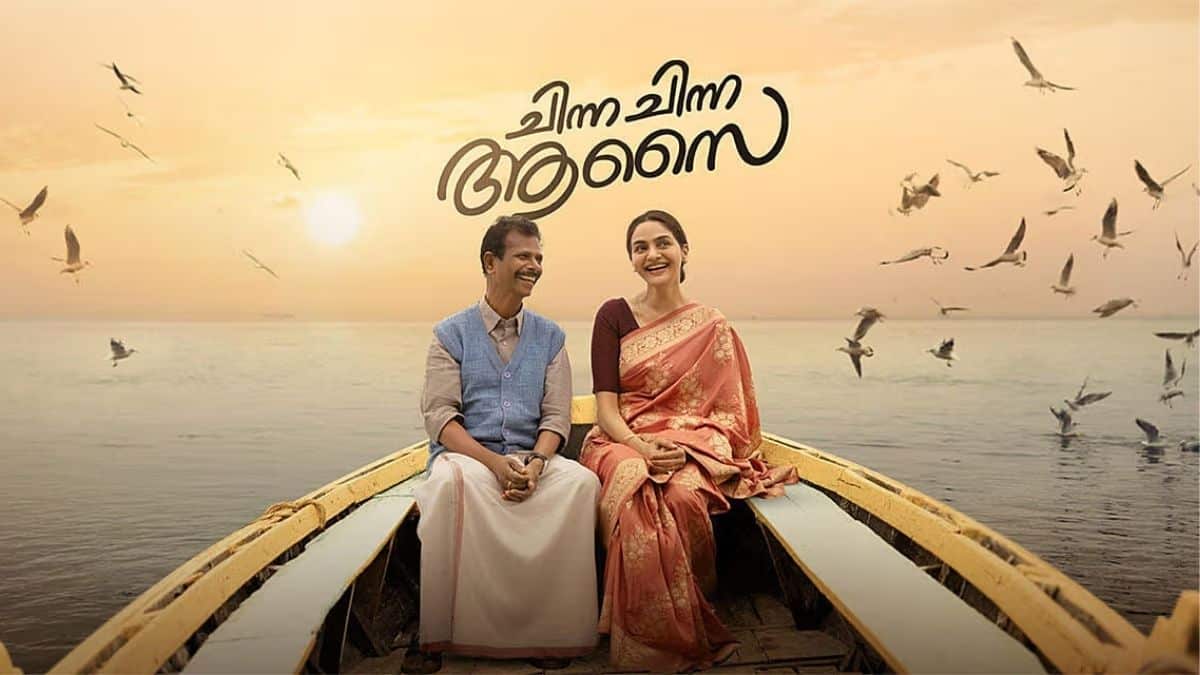
Varsha Vasudev’s assured directorial debut is a gentle, philosophy-laced feel-good drama that lingers long after the credits roll — anchored by two extraordinary performances and Govind Vasantha’s soul-stirring music.
Malayalam cinema has always had a rare gift for finding the extraordinary within the ordinary — for discovering entire universes of feeling inside a glance exchanged between strangers, a walk along a river at dusk, or a conversation that begins with pleasantries and ends with something that can never quite be named. Chinna Chinna Aasai, the debut feature from writer-director Varsha Vasudev, belongs proudly to this tradition. Released on June 19, 2026, and distributed across Kerala by Dulquer Salmaan’s Wayfarer Films, the film arrives as one of the season’s most quietly anticipated releases — and it delivers on every promise its trailer made.
Chinna Chinna Aasai is a deeply human story about a Tamil woman named Leela and a retired Malayali schoolteacher named Madhavan, brought together by chance on the sacred banks of Varanasi. Director Varsha Vasudev weaves a quietly emotional narrative that uses the holy city not merely as a backdrop but as a living, breathing character — a space where unfulfilled desires find unexpected release. At two hours and sixteen minutes, the film moves with deliberate grace, trusting its actors and its setting to carry the emotional weight. The result is a deeply affecting, beautifully crafted film that stands as one of the finest Malayalam releases of 2026.
Cast & Crew
| Role | Name |
|---|---|
| Director | Varsha Vasudev |
| Writer | Varsha Vasudev |
| Producer | Abhijith Babuji |
| Production Banner | Babuji Productions |
| Distributor (Kerala) | Wayfarer Films |
| Madhavan Master | Indrans |
| Leela | Madhubala (Madhusha) |
| Aparna | Aparna Balamurali |
| Shetty | Jaffer Sadiq |
| Vishnu’s Character | Vishnu Agasthya |
| Supporting Role | Thambi Ramaiah |
| Supporting Role | Kaali Venkat |
| Supporting Role | Sai Janani |
| Music | Govind Vasantha |
| Cinematography | Faiz Siddik |
| Editing | Reckson Joseph |
| Art Direction | Sabu Mohan |
| Costume Design | Sameera Saneesh |
| Sound Design | Renganaath Ravee |
| Release Date | June 19, 2026 |
| Runtime | 136 minutes |
| Censor Certificate | U (Universal) |
Plot Summary
Chinna Chinna Aasai follows Leela (Madhubala), a middle-aged Tamil woman who travels alone to Varanasi — a city her late father once described with wonder — to live out a small, personal dream she had buried under decades of family responsibilities. In this ancient city of liberation, she crosses paths with Madhavan Master (Indrans), a retired UP school teacher from Kozhikode who visits Varanasi regularly to spend time with his daughter (Aparna Balamurali), who is studying Kathak at Banaras University.
Both Leela and Madhavan have spent the better part of their lives in service to others — their families, their duties, their obligations — with their own desires quietly shelved. Varanasi, the city where millions arrive in search of moksha, becomes the unexpected stage for a different kind of salvation: the fulfillment of small, personal wishes. What blossoms between the two is neither simple friendship nor conventional romance — it is something richer and more elusive, a bond that the film wisely refuses to reduce to easy labels.
Performances
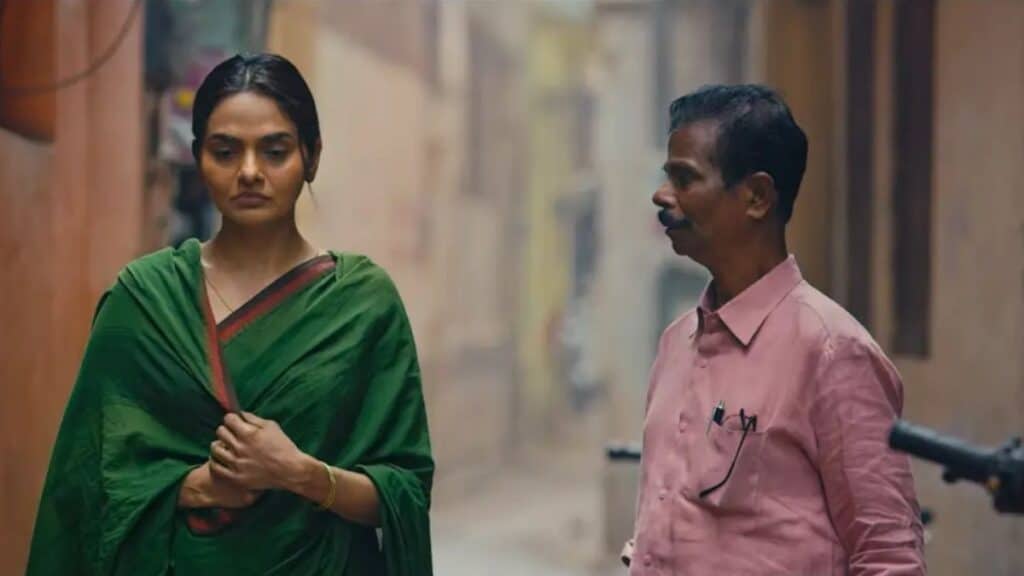
Indrans delivers what may be one of the finest performances of his remarkable career. As Madhavan Master, he embodies a soft-spoken dignity that quietly dismantles you — a man whose warmth, humor, and lingering loneliness are communicated not through dramatic outbursts but through the smallest gestures and glances. Indrans makes Madhavan feel completely real, completely lived-in, and utterly irreplaceable to the emotional architecture of the film.
Madhubala (Madhusha) makes a triumphant return to a strong Malayalam central role after a long gap, and she owns every frame she inhabits. Her portrayal of Leela is nuanced, grounded, and deeply moving — a woman rediscovering herself in a city that strips everything to its essence. Madhubala’s chemistry with Indrans is the beating heart of the film, and she ensures Leela’s emotional journey feels authentic and earned.
Aparna Balamurali brings her characteristic warmth and precision to her role as Madhavan’s daughter. Though the character functions primarily in support of the central relationship, Aparna elevates every scene she appears in, bringing genuine emotional texture to what could have been a relatively peripheral part. Her presence adds an important dimension of family and connection to the narrative.
Jaffer Sadiq is a revelation in a brief but indelible role as Shetty. The character appears on screen for only a short time, yet Sadiq’s performance leaves a mark that persists well beyond his scenes — a testament to how completely he inhabits every moment given to him.
Vishnu Agasthya makes his presence felt with a noteworthy performance that complements the film’s emotional fabric with ease. His scenes contribute meaningfully to the world Varsha Vasudev has built around her leads.
Thambi Ramaiah brings his trademark natural ease and character depth to the ensemble, enriching the film’s human landscape and delivering the kind of grounded support work that quietly elevates the stories around him.
Kaali Venkat is reliably excellent, infusing his role with the personality and spontaneity that has made him one of Tamil and Malayalam cinema’s most dependable supporting actors.
Sai Janani rounds out the ensemble with a warm, well-calibrated performance that fits seamlessly into the film’s gentle, emotionally attuned world.
Technical Craft
Direction — Varsha Vasudev
Varsha Vasudev announces herself as a filmmaker of genuine vision with this debut feature. Having built early attention with her short film Ente Narayanikku, she scales her storytelling with confidence and restraint in equal measure. What distinguishes her direction is the clarity of her intent — she knows precisely the kind of film she is making, and she never loses sight of it. The screenplay structures the first half around dialogue-driven character establishment and the second half around lived emotional experience, a rhythm that proves deeply effective. Vasudev does not chase novelty of plot; she chases depth of feeling, and she finds it.
Cinematography — Faiz Siddik
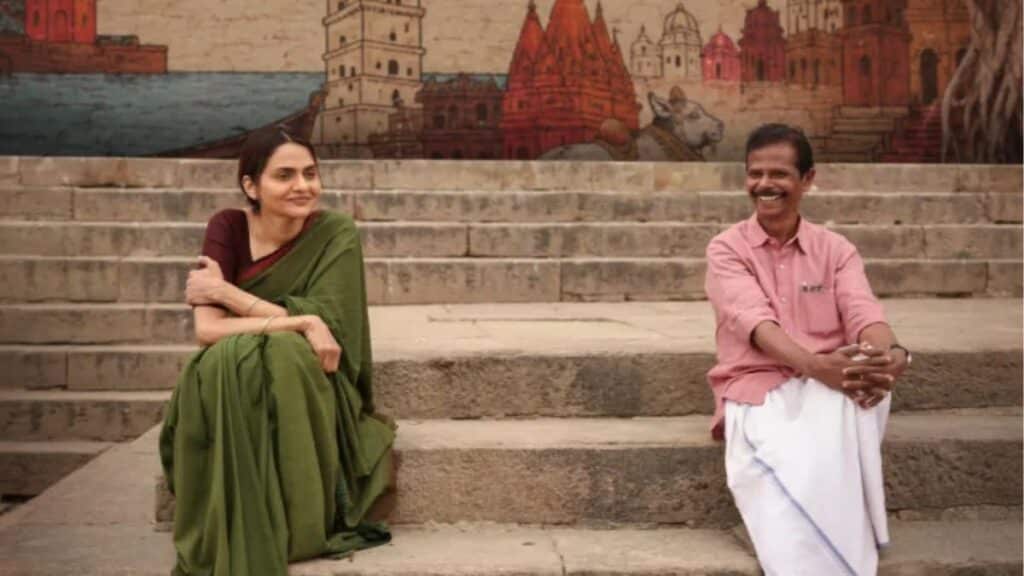
Faiz Siddik’s work is among the film’s most compelling technical achievements. His photography of Varanasi is luminous — he captures the ghats at their most spiritual and their most intimate, treating the city as an emotional entity rather than a postcard. The lighting choices are consistently purposeful, ensuring that even quieter scenes carry a visual weight that reinforces the film’s themes of longing, solitude, and unexpected connection.
Music — Govind Vasantha
Govind Vasantha, renowned for his transformative work on 96, brings the same emotional intelligence to Chinna Chinna Aasai. The film’s six original songs integrate organically into the narrative, never interrupting but always deepening. His background score is perhaps even more impressive — quietly present, philosophically attuned to Varanasi’s essence, and utterly essential to the mood the film seeks to create. The music is inseparable from the film’s emotional success.
Editing — Reckson Joseph
Reckson Joseph’s editing is patient and assured, mirroring the film’s contemplative tone. He allows scenes to breathe without permitting them to drift, maintaining a rhythm that feels natural rather than calculated. His work in the second half — as the relationship between Leela and Madhavan deepens beyond easy definition — is particularly effective.
Strengths & Weaknesses
Strengths
- Extraordinary lead performances — Indrans and Madhubala achieve a rare, wholly believable chemistry that carries the film’s emotional weight effortlessly.
- Varanasi as character — The film’s conceptual use of the city — not merely as backdrop but as philosophical statement — is genuinely inspired.
- Govind Vasantha’s score — Among the most emotionally resonant musical contributions to Malayalam cinema this year.
- Restrained, purposeful storytelling — Varsha Vasudev never overexplains, trusting her audience to feel what the film is saying.
- Universal emotional themes — The film’s meditation on unfulfilled desires and late-life renewal speaks to all audiences regardless of age or background.
Weaknesses
- Deliberate pacing — The first half’s dialogue-heavy approach to character building may test audiences expecting a more plot-driven experience.
- Limited narrative scope — The film is intentionally small in scale; viewers seeking dramatic turns or high-stakes conflict may find the gentleness underwhelming.
Final Verdict: ⭐⭐⭐⭐ / 5 — 4 Stars
Chinna Chinna Aasai is the kind of film Malayalam cinema produces at its most artistically generous — a small, heartfelt story told with complete sincerity and uncommon craft. Varsha Vasudev’s debut announces a filmmaker who understands that cinema’s deepest power lies not in spectacle but in the quiet recognition of shared human experience. Indrans and Madhubala give performances that will stay with you, Govind Vasantha’s music will follow you home, and the philosophy of Varanasi — that the city gives back what you offer it — finds its most unexpectedly beautiful cinematic expression here. Do not miss this one in theatres.
FAQ
What is the age rating of Chinna Chinna Aasai?
The film holds a U (Universal) certificate from the censor board, making it suitable for all audiences.
Is Chinna Chinna Aasai suitable for family viewing?
Yes, absolutely. Chinna Chinna Aasai is a clean, emotionally warm film with no objectionable content. It is particularly well-suited for adult family audiences who appreciate character-driven, slice-of-life cinema.
Is Chinna Chinna Aasai based on a true story?
No, Chinna Chinna Aasai is an original fictional story written by director Varsha Vasudev. The narrative and characters are entirely the work of her imagination, though the emotional truths the film explores will feel deeply familiar to most viewers.
