


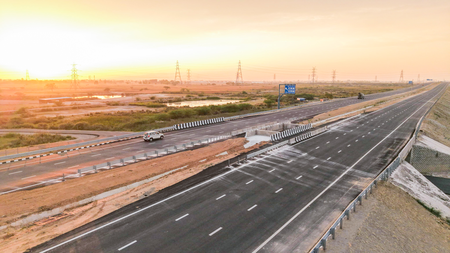
Uttar Pradesh’s Ganga Expressway, stretching nearly 600 km and costing about Rs 36,000 crore, was inaugurated by Prime Minister Narendra Modi. The expressway is set to boost logistics, industrial, and real estate development in 12 districts of the state, as per a recent report.
The Ganga Expressway, connecting Meerut and Prayagraj, is expected to reduce travel time significantly and enhance connectivity with the Delhi-NCR region, promoting regional integration. The corridor is projected to generate value at 18 interchange nodes, with development unfolding in three phases over time.
In the initial phase, ‘Grade A’ warehousing and logistics assets are anticipated to emerge within a 5-km radius of interchange nodes within three years. Subsequently, over two to five years, increased industrial activity, residential demand in district towns, and expansion of retail, education, and healthcare infrastructure are expected within a 5–20 km belt.
Over a longer term of five to ten years, the corridor is likely to witness land aggregation and significant residential and industrial development, particularly in areas currently dominated by agricultural land. The report suggests that the expressway could transform Uttar Pradesh’s growth model into a corridor-based development framework centered on logistics and industry.
Rajeev Vijay, Executive Director of Government and Infrastructure Advisory at Knight Frank India, mentioned that the Ganga Expressway is poised to catalyze real estate development across the 12 districts. He highlighted that the expressway will create a high-speed economic geography linking different sectors of Uttar Pradesh, fostering economic activity within the state and supporting broader growth in northern India.
Meerut and Prayagraj are identified as high-readiness hubs likely to benefit early, while Hardoi, Unnao, and Hapur are emerging as key growth centers with strong industrial and warehousing potential. The District Readiness Index by Knight Frank India places these districts strategically to capture gains from improved connectivity.
Furthermore, the report underscores Uttar Pradesh’s significant role in India’s operational expressway network, accounting for nearly 60% of the total network. Attendees at the inauguration event expressed optimism about the expressway, noting that journeys that previously took 12–13 hours can now be completed in a fraction of the time. The project aims to reduce travel time between Meerut and Prayagraj from 10-12 hours to around six hours.
Notably, the Ganga Expressway features a 3.5-km emergency landing facility in Shahjahanpur, designed as an airstrip to enhance strategic, national security capabilities, and economic benefits.
