


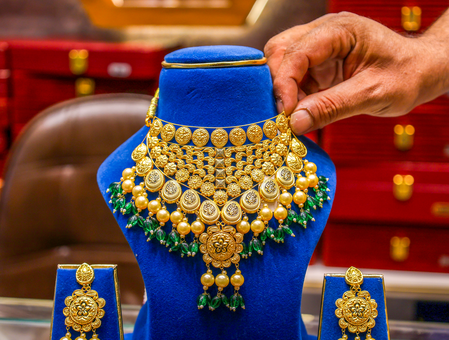
Gold and silver prices experienced fluctuations on Monday due to escalating geopolitical tensions in West Asia, which typically drive safe-haven demand, and a significant increase in US Treasury yields. On the Multi Commodity Exchange (MCX), gold futures for June 5 were trading at Rs 1,58,697 per 10 grams, showing a rise of Rs 150 or 0.09 percent around 11 am. The price of gold reached an intraday high of Rs 1,58,884, marking a rise of Rs 337 or 0.21 percent, while the day’s low was at Rs 1,57,547, a decrease of Rs 1,000 or 0.63 percent.
Silver futures for July 3 on the MCX were trading at Rs 2,71,627 per kg, reflecting a decline of Rs 259 or 0.10 percent. The white metal had earlier dropped by as much as 2.55 percent or Rs 6,937 to hit an intraday low of Rs 2,64,949. However, it also reached an intraday high of Rs 2,74,145, showing an increase of Rs 2,259 or 0.83 percent during the session.
Market analysts noted that precious metals faced global pressure due to a stronger US dollar and rising US Treasury yields following higher-than-expected US inflation data, which reduced expectations of US Federal Reserve interest rate cuts this year. The concerns over inflation linked to the Middle East energy disruption have further raised expectations of tighter global monetary policy, impacting non-yielding assets like gold and silver, according to commodity market experts.
Silver prices were also affected as UBS revised down its full-year silver investment demand forecast and anticipated a narrower global supply deficit. Moreover, in the global market, COMEX gold dropped by 0.39 percent to $4,543 per ounce, while COMEX silver fell by 2.28 percent to $75.778 per ounce. Additionally, global crude oil prices surged due to supply disruption fears following an attack on a nuclear facility in the United Arab Emirates. The international benchmark Brent crude rose by 2.37 percent to $111.86 per barrel, and US West Texas Intermediate (WTI) crude increased by 3.11 percent to $108.70 per barrel.
