


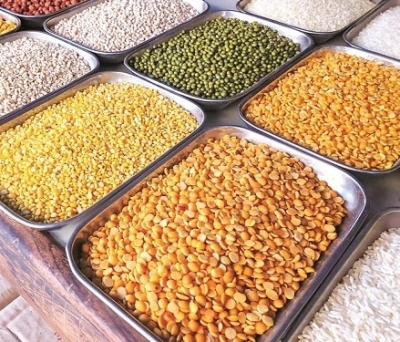
Gujarat has become a prominent pulse-producing state in India, showing a significant increase in output over the last six years. The state’s annual pulse production has surpassed 20 lakh metric tonnes, nearly doubling the levels seen in 2019–20. This growth is attributed to improved irrigation facilities, higher support prices, and enhanced seed varieties.
Data from the agriculture department reveals that between 2019–20 and 2024–25, the area dedicated to pulse cultivation in Gujarat expanded from 9 lakh hectares to 14.39 lakh hectares. Productivity also saw a notable rise during this period, increasing from 1,173 kg per hectare to 1,495 kg per hectare. Consequently, total pulse production escalated from 10.58 lakh metric tonnes to 21.52 lakh metric tonnes.
Chickpea remains the dominant pulse variety in Gujarat, constituting over 70% of the state’s total pulse output. Production of chickpea surged from 6.36 lakh metric tonnes in 2019–20 to 15.63 lakh metric tonnes in 2024–25. Additionally, pigeon pea (tur/arhar) cultivation in the state witnessed a significant growth of approximately 45%, with production rising from 2.10 lakh metric tonnes to 3.08 lakh metric tonnes.
The cultivation of other pulses such as urad, moong, and moth bean has also expanded across various agro-climatic zones in Gujarat. In 2024–25, urad was cultivated over 1.14 lakh hectares, yielding around 90,000 metric tonnes, while moong covered 1.38 lakh hectares, producing nearly 1.26 lakh metric tonnes. Moth bean, suitable for dry and semi-arid regions like Kutch and parts of north Gujarat, was grown over approximately 72,000 hectares, resulting in a production of more than 64,000 metric tonnes.
Officials credit this transformation to a mix of policy and infrastructure interventions. Initiatives in irrigation have ensured increased water availability for rabi and summer crops, prompting farmers to diversify into pulses. Moreover, the rise in minimum support prices, coupled with the adoption of improved seed varieties from state agricultural universities, has further bolstered yields.
The export potential of pulses from Gujarat has provided an added incentive for farmers, leading to an expansion in cultivated area and enhanced productivity. These combined factors have positioned pulses as a significant growth driver in Gujarat’s agricultural sector, underlining the state’s role in India’s food security and the broader objective of fostering a self-reliant India.
