


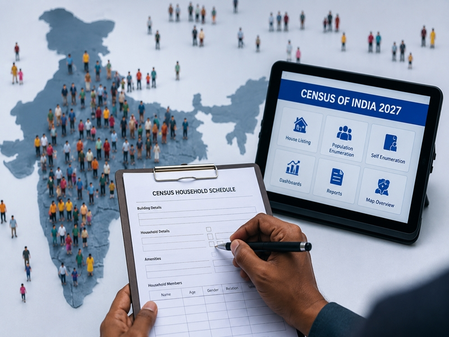
The Gujarat government has released the schedule for the Census of India 2027 in the state. The first phase of house-listing operations will take place from June 1 to June 30 as per a Central government directive under the Census Act, 1948. A gazette notification issued on May 5 details the national framework for census operations and sets state-specific timelines.
While house-listing activities will occur nationwide between April 1 and September 30 this year, Gujarat has a modified schedule within this period. The state will have a 15-day self-enumeration period before field operations start, allowing households to submit census data digitally before door-to-door verification.
As per the revised plan, enumerators will conduct a 30-day house-listing exercise across Gujarat. The census will be conducted in two phases, with the second phase, Population Enumeration, scheduled for February 2027 nationwide. The entire process will be digital through a dedicated census portal and mobile apps, marking India’s first fully digital census.
Officials mentioned that the adjusted timetable was set due to administrative changes related to recent local body elections. This required rescheduling of government responsibilities at the field level to ensure staff availability for census duties. The census was initially proposed for an earlier timeframe but was delayed due to election-related tasks.
The Gujarat census will be part of the 16th Census of India since 1872 and the eighth since Independence. During the house-listing phase, data on housing conditions, amenities, and assets will be collected. This includes information on dwelling structures, sanitation facilities, road connectivity, and other basic infrastructure indicators.
In the Population Enumeration phase in 2027, demographic, socio-economic, educational, migration, and occupational data will be captured. The state government has begun preparatory measures, such as identifying house-listing blocks, creating notional maps, compiling charge registers, and providing training for enumerators and supervisors.
Changes in jurisdiction up to December 31, 2025, will be accounted for to ensure administrative accuracy. The notification also emphasizes stringent data quality protocols, validation methods, and confidentiality provisions under the Act. Public awareness campaigns are planned before the self-enumeration phase and field operations to encourage participation.
Census data will be crucial for evaluating household amenities, socio-economic conditions, demographic trends, and will aid in planning and governance at state and national levels.
