


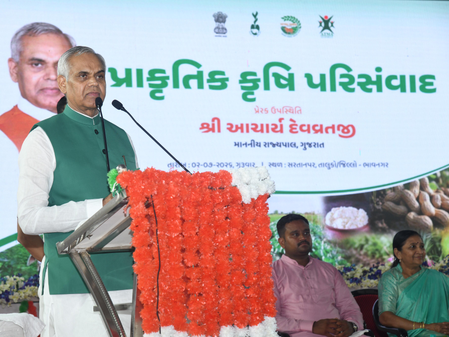
Gujarat Governor Acharya Devvrat emphasized the importance of expanding natural farming with public involvement to cut farming expenses, enhance public health, and establish a “poison-free India.” He highlighted that natural farming goes beyond agriculture, serving as a national mission tied to human health, environmental preservation, soil fertility, and the well-being of future generations.
Devvrat pointed out that the overuse of chemical fertilizers and pesticides has led to soil, water, air, and food contamination, resulting in severe diseases and significant financial burdens due to fertilizer imports and healthcare costs. He urged the public to make natural farming a people’s movement to create a toxin-free India through active participation.
The Governor stressed that nature has its own way of maintaining soil fertility, with earthworms, microorganisms, and indigenous cow-based farming enhancing soil health and supporting rainwater conservation. In contrast, chemical farming has been noted to harden soil and impede groundwater recharge, emphasizing the benefits of natural farming in reducing costs, boosting soil health, producing safe and nutritious food, and increasing farmers’ incomes.
Devvrat cited a scientific study revealing traces of pesticides, detergents, and urea in breast milk samples from 105 women, signaling a serious health risk for current and future generations. Drawing from his experience in Himachal Pradesh, he highlighted the success of natural farming in motivating thousands of farmers to adopt the practice, with numbers now reaching into the lakhs.
Encouraging broader participation, Governor Devvrat called on existing natural farming practitioners to inspire at least ten more farmers in their villages to embrace the method. He also urged local residents to adopt natural farming on a mission-oriented scale. Minister of State Nimuben Bambhaniya commended the Governor’s efforts in promoting natural farming and increasing public engagement across Gujarat’s talukas.
Bambhaniya emphasized that natural farming is a potent tool for farmers’ prosperity, preserving soil fertility, cutting production costs, ensuring high-quality, toxin-free crops, and elevating farm incomes. She encouraged farmers to leverage government agricultural schemes, modern technology, and market support while scaling up natural farming practices.
Governor Devvrat and MoS Bambhaniya visited stalls showcasing natural farming produce and engaged with farmers during the event. The Governor recognized four farmers practicing natural farming with Taluka-Level Best ATMA Farmer Awards, underscoring the importance of sustainable agricultural practices in fostering a healthier agricultural ecosystem.
