


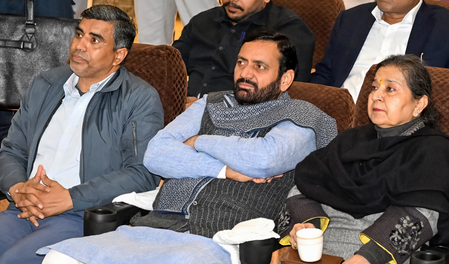
Haryana Chief Minister Nayab Singh Saini hailed the Union Budget as a visionary and historic document that will contribute to the development of a Viksit Bharat. He expressed appreciation towards Prime Minister Narendra Modi and Finance Minister Nirmala Sitharaman for the welfare-focused Budget, emphasizing its key pillars of speed, capacity, and inclusive growth. The government’s plan to boost public capital expenditure to Rs 12.2 lakh crore by 2026-27 was highlighted as a significant move that will drive progress in industrially and infrastructure-focused states like Haryana.
The allocation of Rs 10,000 crore for the MSME sector in the Budget was noted by CM Saini as particularly beneficial for Haryana. Additionally, he mentioned that the development of 15 archaeological sites will enhance global recognition for historical heritage sites in Haryana, such as Rakhigarhi. Furthermore, investments in AI and Quantum Mission were seen as measures that will reinforce Gurugram’s standing as a global tech hub.
CM Saini also lauded the provision of Central assistance for the reclamation of saline and waterlogged land in Haryana, emphasizing its positive impact on the state’s farmers. He commended the increased allocation for the agriculture sector and the focus on the Digital Agriculture Mission as steps towards boosting farmers’ income. The Budget’s initiatives, including the establishment of large textile parks and high-speed rail corridors nationwide, were seen as pivotal towards positioning India as the world’s third-largest economy.
State Transport Minister Anil Vij echoed the sentiment, praising the Budget for its visionary and inclusive approach that directly benefits all segments of society. He highlighted the Budget’s alignment with the goal of a Developed India by 2047 under Prime Minister Modi’s leadership, likening the progress to the speed of a bullet train. Vij emphasized the Budget’s consideration for farmers, workers, the middle class, industry, youth, and women, noting its focus on current needs while also planning for future economic and social requirements.
