


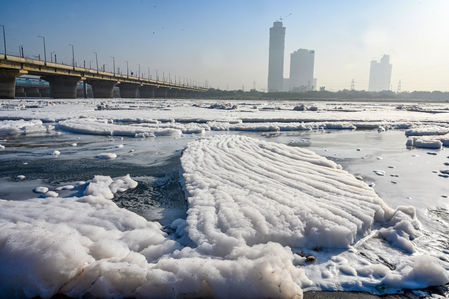
The Haryana government has initiated a significant action plan to revive the Yamuna river and minimize pollution flowing into Delhi through inter-state drains. Chief Secretary Anurag Rastogi led a review meeting to assess the state’s pollution control strategy, emphasizing sewage treatment, industrial waste management, and real-time monitoring of drain pollution. The focus is on enhancing sewage treatment infrastructure, lowering biochemical oxygen demand, and closely monitoring industrial discharges throughout the state.
The review meeting also addressed the implementation of the Ministry of Home Affairs’ directives on sewerage and industrial waste management in Haryana. Discussions encompassed pollution control measures for inter-state drains like Drain No. 6, Mungeshpur Drain, Bupania Drain, and Palam Vihar Drain, which impact Delhi. Haryana State Pollution Control Board Chairman Vinay Pratap Singh announced plans for zone-wise drone surveys to map drains discharging into the Yamuna, aiming to identify pollution hotspots and enhance source-level monitoring.
Haryana has operationalized 90 sewage treatment plants with a total treatment capacity of 1,518 million liters per day across 34 towns. Moreover, the state is constructing four sewage treatment plants with a capacity of 170 million liters per day and upgrading nine plants with a capacity of 227 million liters per day for improved treatment efficiency. On the industrial front, 17 common effluent treatment plants with a combined capacity of 184.5 million liters per day are functioning in Haryana.
Officials disclosed that two common effluent treatment plants with a capacity of 19 million liters per day are undergoing upgrades, while eight new plants with a capacity of 146 million liters per day are proposed to bolster industrial wastewater treatment infrastructure. The state is planning nine new sewage treatment plants with a projected treatment capacity of 510 million liters per day as part of its future expansion strategy. The Haryana State Pollution Control Board has devised a comprehensive action plan encompassing sewage treatment plants, common effluent treatment plants, and drain-tapping projects to ensure adherence to pollution control regulations.
