


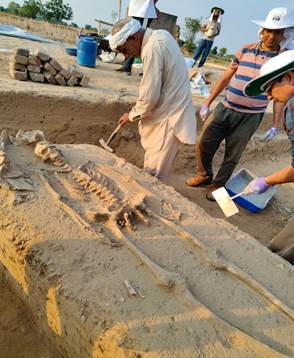
Human skeletal remains discovered at the Rakhigarhi archaeological site in Haryana have been officially transferred by the ASI to the Anthropological Survey of India (AnSI) for in-depth scientific examination. This handover, facilitated by a recent MoU between the two institutions, is set to propel interdisciplinary research into a key urban hub of the Indus-Saraswati Civilization.
The skeletal findings offer a unique opportunity for the application of advanced scientific methods such as ancient DNA analysis, stable isotope studies, osteological assessments, palaeopathological investigations, and environmental reconstruction. These analytical approaches aim to yield crucial insights into ancestry, migration trends, dietary habits, disease prevalence, adaptive strategies, and human-environment dynamics during the Harappan era.
Rakhigarhi, sprawling over about 550 hectares in Haryana, stands as the largest documented settlement of the Indus-Saraswati Civilization. Unearthing activities have unveiled a history of continuous inhabitation from the Early Harappan to the Mature Harappan periods, showcasing planned urban setups, drainage systems, artisan hubs, commercial linkages, and burial sites.
During recent excavations by the Archaeological Survey of India’s (ASI) Excavation Branch-II, Greater Noida, eight burials were unearthed at Mound No. 7, previously identified as a cemetery. Among these discoveries were three intact human skeletons and skeletal fragments, now relocated to AnSI’s ancient human skeletal repository and laboratory in Kolkata for meticulous scrutiny.
