


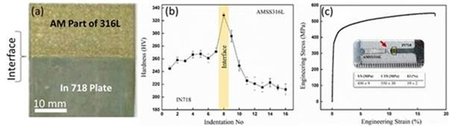
Researchers at Hyderabad’s International Advanced Research Centre for Powder Metallurgy and New Materials (ARCI) have created a crack-free bi-metallic structure using laser-based powder bed fusion technology. This innovation aims to reduce the reliance on costly superalloys and imports. The structure combines stainless steel and nickel-based superalloys, offering a solution for applications in aerospace, nuclear, and thermal power plants.
The gas turbine industry faces challenges with varying temperatures in different regions of the turbine. By combining stainless steel with nickel-based superalloys in a single component, the researchers have addressed these challenges. Traditional welding methods struggle with the differences in chemical composition and melting temperatures between stainless steel (SS316L) and Inconel superalloy (IN718). However, the new technique has successfully produced a crack-free bi-metallic structure with strong interfacial integrity.
The fabricated bi-metallic structure exhibited high hardness and ultimate tensile strength, showcasing its mechanical robustness. Published in the journal Progress in Additive Manufacturing, this research opens doors for creating multi-material components for demanding industrial environments. Potential applications include boiler tubes, heat exchangers for power plants, and advanced energy systems, catering to varying temperature and stress conditions in different component sections.
The technology developed by the research team led by S. Narayanaswamy and others is crucial for industries requiring corrosion resistance and high-temperature strength, such as nuclear reactors and oil and gas processing. In the aerospace sector, the bi-metallic structure offers load-bearing capabilities with high-temperature resistance, enhancing component performance. Additive Manufacturing allows for strategic placement of superalloys in regions exposed to extreme thermal conditions, further improving component efficiency.
