


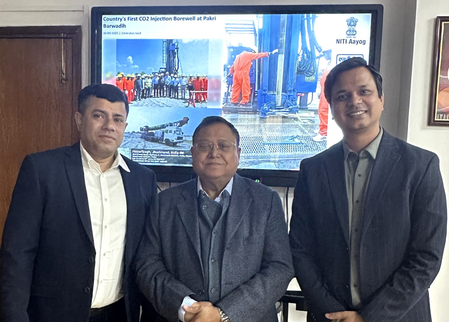
Indian Institute of Technology (IIT) Bombay and NTPC have finished drilling India’s inaugural well to assess the feasibility of storing carbon dioxide (CO2) geologically in sedimentary formations like coal and sandstone. This collaboration, initiated under NITI Aayog in November 2022, involved NETRA from NTPC and the Department of Earth Sciences at IIT Bombay to create India’s first geological storage atlas for coalbed methane-rich coalfields. The atlas offers detailed simulation outcomes for quantifying the potential of geological CO2 storage in four major coalfields.
India accomplished its first dedicated well, reaching a depth of 1200m in September, for potential CO2 storage. The drilling took place in Pakri Barwadih, near a coal mining area in Jharkhand’s Hazaribagh, and concluded on November 15. A second well drilling commenced on December 21, aiming to implement CO2 injection and plume monitoring using these wells, as per the institute.
Dr. V.K. Saraswat, a Member of NITI Aayog, highlighted the significance of accelerating indigenous science and technology outcomes for the commercialization of Carbon Capture, Utilization, and Storage (CCUS) technologies in India’s journey towards ‘Atmanirbhar’ and ‘Viksit’ Bharat commitments. Gurdeep Singh, CMD of NTPC, described the completion of the drilling as a crucial step towards decarbonization. Prof. Shireesh Kedare, Director of IIT Bombay, emphasized the role of translational R&D in shaping India’s energy transition and decarbonization roadmap.
The project signifies a shift from laboratory research to field deployment, providing feasibility and risk assessments for full-scale CCS development, including detailed storage complex analysis and a commercial development plan. Initial studies suggest a high potential for geological CO2 storage in the North Karanpura coalfield, with the Pakri-Barwadih block displaying the potential to inject up to 15.5 Mt over a 10-year period. In 2017, IIT Bombay and NTPC collaborated to establish India’s first CO2 capture and utilization facility in the power sector, leading to the Vindhyachal CCU plant that converts 20 tonnes of CO2 daily into fuel-methane.
India’s journey in CCUS is progressing through a mission-mode approach, with the Ministry of Power as the nodal agency, supported by inter-ministerial collaboration to expand CCUS technologies across hard-to-abate sectors.
