


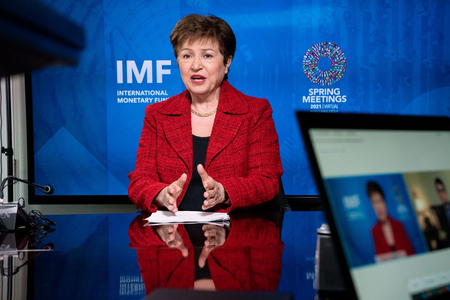
International Monetary Fund (IMF) Managing Director Kristalina Georgieva cautioned that if the Middle East conflict extends into 2027, the global economy could face a significant downturn, with oil prices potentially reaching $125 per barrel. Speaking at a conference in Washington, D.C., she highlighted the risks of escalating inflation and the destabilization of inflation expectations.
Georgieva pointed out that ongoing factors such as prolonged conflicts, oil prices remaining at or above $100 per barrel, and increasing inflationary pressures have already triggered the IMF’s “adverse scenario.” The IMF had previously outlined three scenarios for global GDP growth in 2026 and 2027, including a main “reference forecast,” a middle “adverse scenario,” and a more severe “severe scenario.”
Under the adverse scenario, global growth could slow to 2.5% in 2026, accompanied by a 5.4% inflation rate. In contrast, the reference scenario, assuming a brief conflict, predicts a growth rate of 3.1% and an inflation rate of 4.4%. Georgieva expressed concern that the severe scenario forecast, with global growth at just 2% and inflation at 5.8%, could become a reality if the situation worsens.
Despite a recent drop in global crude oil prices following US President Donald Trump’s assurances to aid stranded vessels in the Strait of Hormuz, prices remained above $100 per barrel due to the lack of progress in US-Iran talks. Brent crude fell by 0.61% to $107.51 per barrel, while US West Texas Intermediate (WTI) dropped by 2.77% to $99.11 a barrel.
