


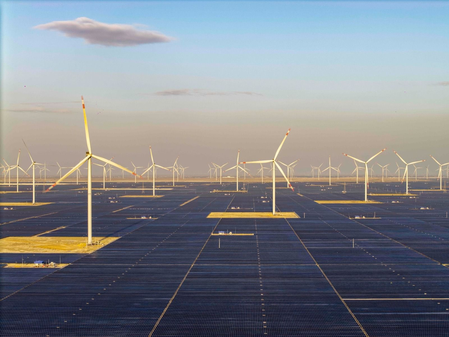
The Indian government announced that the country has reached its highest-ever annual wind capacity addition of 6.05 GW in the fiscal year 2026, surpassing the milestone of 5.5 GW added in FY 2016-17. This marks a substantial 46% increase from the previous year, indicating a significant boost in India’s onshore wind deployment. The Ministry of New and Renewable Energy stated that India’s cumulative installed wind power capacity has now exceeded 56 GW, showcasing a resurgence in the sector driven by various factors such as improved policy clarity and competitive tariff discovery.
India’s wind energy sector has exhibited consistent growth, supported by government initiatives like Concessional Custom Duty on specific components, Waiver of Inter-State Transmission System (ISTS) charges until June 2028, and the implementation of competitive bidding mechanisms. Additionally, the country has introduced separate Wind Renewable Consumption Obligation (RCO) frameworks and received technical assistance from the National Institute of Wind Energy.
The latest wind capacity addition significantly bolsters India’s renewable energy portfolio and aligns with the national objective of achieving 500 GW of non-fossil fuel-based energy capacity by 2030. The wind energy program in India was initiated in the early 1990s as part of the broader renewable energy strategy. Over the past three decades, India has established a robust wind energy ecosystem and a supportive policy framework to encourage grid-connected wind power projects, as highlighted by the ministry.
This milestone accomplishment is attributed to continuous policy backing, enhanced project implementation, and increased maturity of project pipelines in key wind states. States like Gujarat, Karnataka, and Maharashtra have emerged as primary contributors to the capacity addition, driven by the expansion of wind-solar hybrid projects and the gradual introduction of green energy open access, as per the ministry’s statement.
