


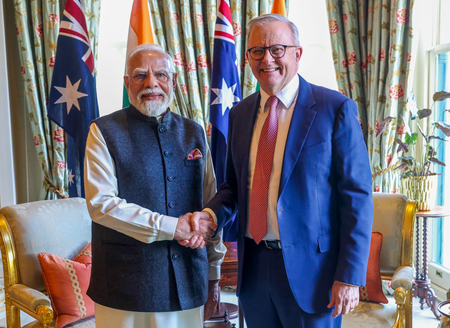
India and Australia recently signed multiple agreements covering defense, economic security, energy, education, science, technology, and culture during Prime Minister Narendra Modi’s visit to Melbourne. The visit, held from July 8-10, included meetings with Australian Prime Minister Anthony Albanese, discussions with business leaders, and an address to the Indian diaspora at Melbourne’s Docklands Stadium, attended by 35,000 people, including speeches from Albanese and Victoria’s Premier Jacinta Allan.
The agreements signed during the visit signify a significant step in the institutionalization of the relationship between the two nations. These agreements encompass various areas such as defense, economic security, energy, education, science, technology, and cultural ties, showcasing the depth and breadth of the bilateral partnership.
One of the key focuses of the agreements was on security cooperation, with the introduction of a new Joint Declaration on Defense and Security Cooperation. Both countries have decided to establish an Annual Defense Ministers’ Dialogue, enhance interoperability between their armed forces, and increase military exercises under the Mutual Logistics Support Arrangement, emphasizing the importance of security collaboration between India and Australia.
In a move to strengthen energy cooperation, the two nations finalized administrative arrangements to facilitate the export of Australian uranium to India for peaceful purposes. This landmark agreement is expected to bolster India’s clean energy goals and further enhance bilateral cooperation in the energy sector. The decision to allow uranium exports to India, despite its status outside the Nuclear Non-Proliferation Treaty, reflects the growing trust and strategic understanding between the two countries.
The agreements signed during Prime Minister Modi’s visit underscore the comprehensive nature of the Australia-India relationship, emphasizing the long-term strategic partnership that extends across various aspects of national policy. The collaboration between the two nations not only highlights their bilateral ties but also emphasizes the importance of people-to-people connections, education, science, and technology in strengthening the social foundations of defense and economic cooperation.
