


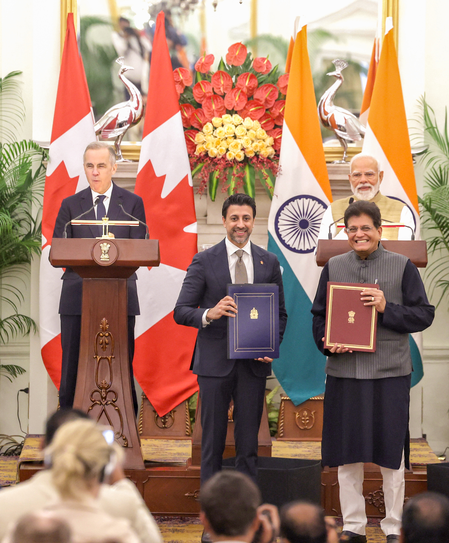
Trade discussions between India and Canada, previously hindered by political tensions, have been reignited during Canadian Prime Minister Mark Carney’s recent visit. This development offers an opportunity to foster a robust bilateral economic relationship in a shifting geopolitical landscape, as noted by India’s former High Commissioner to Canada, Sanjay Kumar Verma.
Verma emphasized the necessity for Canada to diversify its economic reliance on the United States, making India a crucial strategic partner rather than just another market. The move towards an Early Progress Trade Agreement (EPTA) in 2022 signifies a pragmatic approach that could pave the way for a comprehensive economic partnership agreement (CEPA) in the future.
The envisioned CEPA is viewed as a phased process, starting with the consolidation of EPTA provisions and gradually incorporating more intricate elements like investment protection, digital trade, and regulatory cooperation. Sensitive areas such as agriculture, intellectual property, and public procurement are earmarked for later stages when the economic and political environment is more conducive, according to Verma.
The article also underscores the potential for growth in goods and services trade between the two nations. Improved market access, simplified rules of origin, and deeper engagement in sectors like information technology, education, and professional services could bolster economic ties. Additionally, customs facilitation is highlighted as a critical factor in reducing transaction costs and enhancing predictability.
Canada and India already share strong investment connections, with Canadian funds investing in India’s infrastructure and renewable energy sectors, and Indian firms expanding into Canada’s services industry. This investment network provides a solid foundation for trade negotiations and fosters stability. However, ensuring a predictable taxation and repatriation framework is crucial to sustaining and expanding Canadian investments while balancing regulatory autonomy with investor confidence.
Verma advocates for insulating the trade agreement from past political disruptions by establishing robust dispute resolution mechanisms, regular reviews, and institutional frameworks that operate independently of political fluctuations. Involving the private sector in a structured capacity can also help stabilize economic relations during times of governmental discord.
