


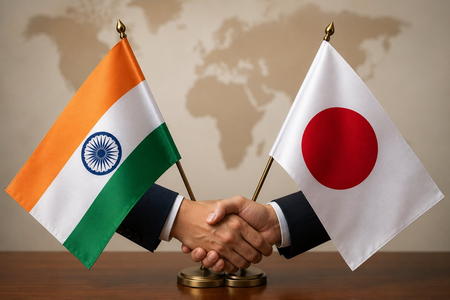
India and Japan have bolstered their strategic partnership through a series of agreements encompassing various crucial areas such as economic security, artificial intelligence (AI), defense technology, clean energy, healthcare, and maritime security. This development follows discussions between Prime Minister Narendra Modi and Japanese Prime Minister Sanae Takaichi in New Delhi. Takaichi’s three-day official visit to India, from July 1 to 3, was at the invitation of PM Modi, with both leaders engaging in comprehensive talks to enhance bilateral cooperation amidst global challenges.
During a joint press briefing post the discussions, PM Modi highlighted the agreement on a joint economic security roadmap to tackle global uncertainties. The focus of this roadmap lies in establishing robust supply chains in critical sectors like semiconductors, quantum technologies, and advanced materials. Emphasizing the significance of economic and energy security in today’s uncertain times, PM Modi stressed the necessity for reliable partnerships in critical technologies and manufacturing.
Furthermore, India and Japan issued a joint statement on collaboration in artificial intelligence, showcasing their mutual dedication to advancing cooperation in emerging technologies. PM Modi expressed that the technology partnership between the two nations would serve as a cornerstone of their bilateral relations. He noted that the fusion of Japan’s precision technology with India’s software capabilities would inject fresh impetus and vigor into global AI progress.
In a notable stride towards enhancing defense cooperation, India and Japan inked an agreement for their inaugural joint defense co-development project involving the naval radio antenna system “Unicorn.” PM Modi hailed this agreement as the commencement of a new phase in defense technology collaboration between the two countries. He articulated that the joint development of defense technologies would fortify regional peace, maritime security, and the rules-based order.
Additionally, the two nations signed pacts to broaden cooperation in pharmaceuticals, medical devices, and biotechnology. PM Modi highlighted that India’s manufacturing scale, coupled with Japan’s technological prowess and quality standards, could facilitate the provision of cost-effective, reliable, and advanced healthcare solutions globally.
