


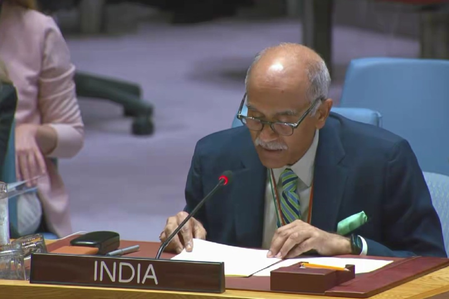
India has urged for action to be taken against those who attack schools and children, labeling the situation of children in conflict areas as a “damning verdict on humanity’s collective failure.” During a Security Council discussion on children and armed conflicts, India’s Permanent Representative to the UN, P. Harish, emphasized the importance of holding accountable those who harm schools and children.
The Secretary-General’s report on children and armed conflict highlighted a 44% increase in attacks on schools in a single year (2025). It was noted that over 473 million children, more than one in six globally, are residing in or fleeing conflict zones, with over 85 million having no access to education at all.
India showcased its digital education platform, DIKSHA (Digital Infrastructure for Knowledge Sharing), as a potential model for educating children affected by conflict or displacement. The platform has facilitated access to quality learning through interactive content and AI-powered tools in various languages, aiming to bridge the education gap during conflicts.
Emphasizing the significance of education for those most impacted by war, India has made substantial investments in education for refugees and displaced communities in neighboring regions. The country has focused on reconstructing education infrastructure, including schools and vocational training centers, in different nations, underscoring the importance of continuous learning for resilience and recovery.
United Nations Children’s Fund (UNICEF) Executive Director Catherine Russell expressed concerns about the use of drones, autonomous systems, and AI-supported targeting systems, which exacerbate the risks faced by children and schools in conflict zones. She stressed the need for unwavering commitment to safeguarding children amidst evolving warfare tactics.
Secretary-General’s Special Representative for Children and Armed Conflict, Vanessa Frazier, highlighted that the previous year witnessed the highest number of serious violations against children in at least three decades. In 2025, the UN documented 38,558 grave violations affecting 24,174 children, marking the highest number of violations reported in the past 30 years.
