


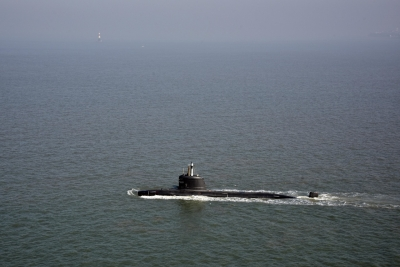
India has developed the S5 SSBN, a large-displacement nuclear-powered ballistic-missile submarine, to enhance its maritime presence and safeguard vital sea routes against regional threats, particularly from China and Pakistan. Weighing approximately 13,500 tonnes, the S5-class submarine represents a significant advancement in India’s nuclear deterrent capabilities, surpassing the size of its predecessor, the Arihant-class submarines. Construction of the S5 SSBNs commenced in late 2025, with plans for at least four submarines to ensure continuous deterrence patrol by the 2030s.
Part of the Indian Navy’s strategy to expand its fleet significantly by 2035, the S5 submarine is designed to offer a survivable sea-based second-strike capability and support India’s ambitions for blue-water operations. The deployment of S5 submarines not only enhances India’s deterrence capabilities but also extends its blue-water reach, complicating adversary naval strategies and bolstering maritime diplomacy in the Indian Ocean Region.
The term “blue water reach” refers to the Indian Navy’s capacity to safeguard personnel, vessels, cargo, and other assets beyond its immediate shores, enabling operations in the deep oceans beyond the Indian Ocean Region. This capability allows for sustained operations across open seas, encompassing long-distance deployments, amphibious warfare, maritime strike capabilities, and global presence.
Covering waters from the Persian Gulf to the Malacca Strait on one side and from the Bay of Bengal to the Indian Ocean and Africa’s east coast on the other, the Indian Navy faces challenges posed by the combined naval strength of China and Pakistan. The S5 submarines, equipped with advanced stealth technologies and a 190 MW Pressurised Water Reactor (PWR) developed by the Bhabha Atomic Research Centre (BARC), are expected to carry up to 12 K6 submarine-launched ballistic missiles, each capable of deploying multiple independently targetable reentry vehicles (MIRVs).
The development of these submarines for the Indian Navy marks a crucial step towards establishing a future blue-water navy capable of competing with China’s People’s Liberation Army Navy even in distant waters. India’s military capabilities, including the S5 program, are evolving in a region characterized by changing alliances, growing China-Pakistan cooperation, and fluctuating relations with neighboring countries. The SSBN program not only reflects but also reinforces India’s strategic autonomy, signaling deterrence against coercion and enhancing New Delhi’s influence in maritime security dialogues and partnerships in the Indian Ocean Region.
By transitioning to a blue water navy, India gains the ability to operate further away from its coastlines compared to a green water navy, enabling extended deployments in open oceans for prolonged periods. This expansion of naval power includes the deployment of aircraft carriers, additional naval vessels, and logistical support necessary for sustained operations far from home. Ultimately, a blue water navy allows India to project power across vast maritime territories, controlling strategic areas distant from its shores.
