


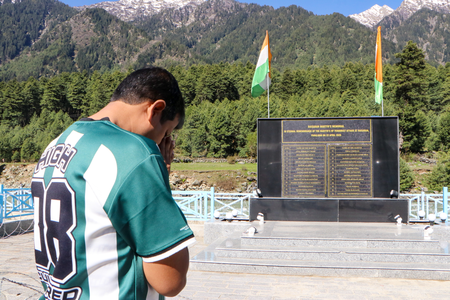
India, through a thorough investigation by the National Investigation Agency (NIA), has confirmed a direct link to Pakistan in the Pahalgam attack, resulting in the loss of 26 lives. The attack, orchestrated by Saifullah alias Sajid Jatt alias Langde from Lahore, a key member of Lashkar-e-Tayiba, revealed a clear pattern before and after the tragic incident on April 22, 2025.
Pakistan initially believed they could escape repercussions for the attack but changed their stance as global condemnation mounted and India geared up for a robust response. The shift in Pakistan’s attitude followed provocative remarks by Pakistan’s army chief, Asim Munir, emphasizing Kashmir’s strategic importance and hinting at potential conflict.
The inflammatory rhetoric by Munir, including references to past wars over Kashmir and divisive religious ideologies, was seen as a deliberate attempt to incite violence. Subsequently, The Resistance Front, a Lashkar-e-Tayiba offshoot, claimed responsibility for the attack but swiftly retracted its statement amid escalating tensions and the threat of Indian retaliation.
The Pakistani establishment, realizing the gravity of the situation and India’s readiness for a strong countermeasure, advised The Resistance Front to backtrack on its initial claim and instead propagate a false narrative to distance themselves from the attack. This strategic shift was driven by the fear of India treating the incident not as cross-border terrorism but as an act of war, catching Pakistan unprepared for a military confrontation.
Investigations by the NIA pinpointed the operational centers in Pakistan responsible for orchestrating the attack, including the Telegram channels ‘Kashmir Fight’ and ‘The Resistance Front_OfFcial.’ The recovery of mobile phones from the attackers further solidified the Pakistan connection, with evidence tracing back to specific locations in Pakistan where the devices were purchased.
The NIA’s findings highlighted the direct involvement of Lashkar-e-Tayiba operatives, notably Saifullah, in managing and executing the Pahalgam attack. Additionally, two local Pakistanis, Bashir Ahmed and Parvez, aided the terrorists during the assault, while reconnaissance missions conducted prior to the attack provided crucial intelligence for the operation.
In response to the Pahalgam attack, India launched ‘Operation Sindoor,’ targeting and dismantling significant terror infrastructure linked to Lashkar-e-Tayiba, Jaish-e-Mohammad, and Hizbul Mujahideen, underscoring a robust retaliation against cross-border terrorism.
