


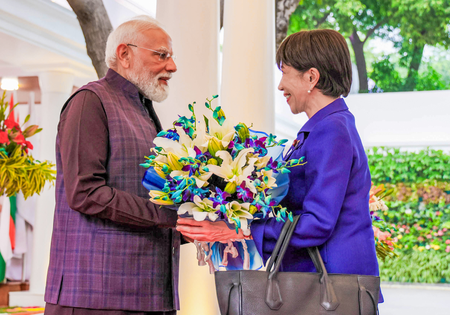
The recent 16th India–Japan Annual Summit in New Delhi highlighted the strategic direction of the bilateral relationship rather than focusing on individual agreements. Former Indian diplomat Sanjay Kumar Verma emphasized Prime Minister Narendra Modi’s pivotal role in fostering strategic continuity and momentum in the partnership. The summit marked a shift towards a new phase of engagement termed “Strategic Trust,” indicating a deeper level of cooperation beyond development assistance and trade.
The Joint Statement issued post the summit signifies a significant change in how India and Japan perceive each other, moving towards reliance on shared capabilities in areas crucial to national resilience, technological strength, and economic security. Prime Minister Modi’s consistent attention over the past decade has been instrumental in shaping the partnership’s direction and continuity. Defence and maritime security cooperation, including joint exercises and enhanced interoperability, remain fundamental pillars of the relationship, with a focus on defence industrial collaboration and co-development.
The partnership’s strategic direction is further reinforced by mutual commitments to maritime cooperation, regional connectivity, and a Free and Open Indo-Pacific vision. This alignment between India’s Indo-Pacific strategy and Japan’s advocacy underlines a broader pattern of strategic coordination among major Indo-Pacific democracies. The evolving India–Japan ties are now centered around shared capabilities rather than individual projects, indicating a shift towards shaping the strategic landscape through collaboration.
Deeper cooperation between India and Japan in technology, supply chains, and defence is expected to draw attention globally, particularly in Beijing. This enhanced partnership not only holds significance at a bilateral level but also carries broader geopolitical implications within the Indo-Pacific region. As geopolitical dynamics evolve and technology advances, countries are reevaluating their partnership-building strategies to prioritize resilience, technological sovereignty, and trusted collaboration in the new era of global relations.
